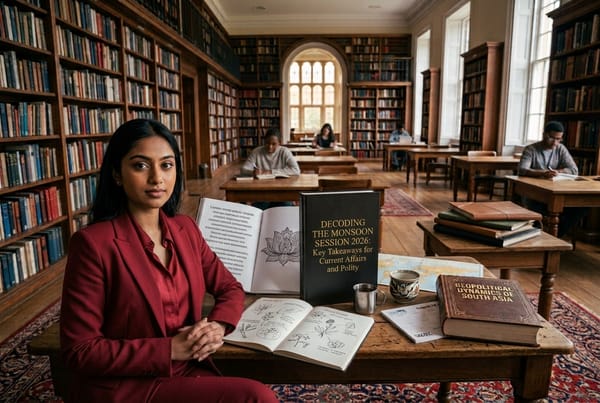
The New Manual for Competitive Exams: Why Depth Beats Breadth and Revision is the Key to 2026

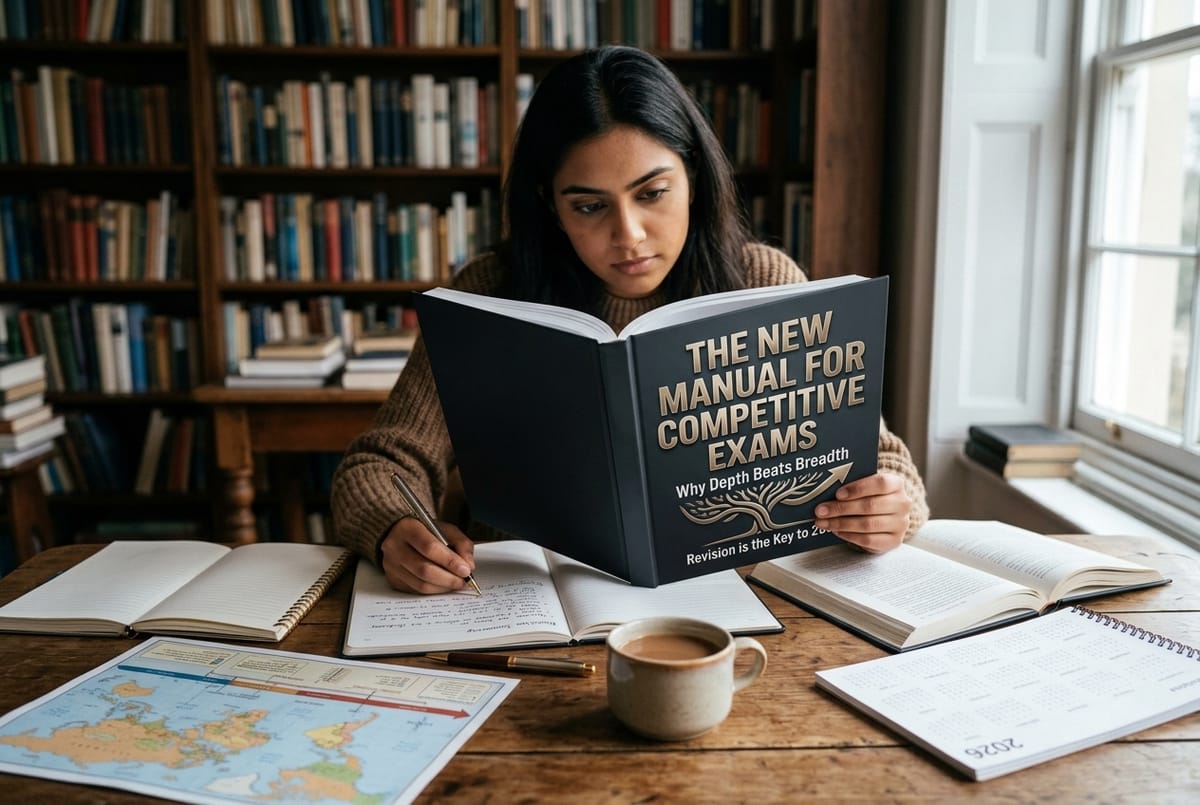
The landscape of competitive exams has changed. What was once a race to "cover" as many topics as possible has now become a battle of intelligence and retention. With an abundance of materials, video lectures, and AI-generated summaries, the true differentiator for a candidate is no longer how many pages they've read, but how they've processed and internalized the knowledge.
If you are preparing for UPSC, SSC, Banking, Railways, or any other major exam in 2026 and 2027, this article is your new survival manual. We will deconstruct the strategies that actually work, based on the routines of successful candidates and the new demands of examination boards.
The End of the "Endless Content" Era
For decades, the standard strategy was simple: accumulate as much material as possible. However, experts and educators observe that while study materials have never been more abundant, results haven't kept pace with this growth. Abundance has become an obstacle.
The most common trap? Confusing familiarity with a concept with mastery over it. You might "recognize" a history or geography topic when you see it in a summary, but that is very different from being able to apply that knowledge to solve a complex question in the exam. The candidate who merely seeks to cover content ends up superficially dominating a vast range of subjects, without depth in any of them.
- The Solution: Embrace the "less is more" strategy. Instead of collecting 10 books on the same subject, choose one or two reliable sources and study them to exhaustion. The key to success isn't finding the "perfect" material, but in revising the material you already have repeatedly.
Revision as a Daily Habit, Not a Final Sprint
If there's one secret that all successful candidates share, it's the importance of revision. However, the most fatal mistake a candidate can make is treating revision as a final step, happening only in the days leading up to the exam.
When you leave a topic to revise two months after studying it, it has already become a blur in your memory. Recovering it will require days of effort. On the other hand, if you revise the same concept days or weeks later, while it's still "fresh," the reinforcement will take only minutes.
- The Successful Candidate's Strategy:
- Weekly Revision Cycle: Dedicate one day of the week (like Sunday) exclusively to revising everything studied in the previous days.
- Daily Revision: Before starting a new topic, spend 15-20 minutes quickly revising the previous day's content. This "anchors" the knowledge in your long-term memory.
- Active Revision: Don't just "read" or "skim." Actively test your memory. Try to explain the concept aloud, as if you were giving a lecture. Use flashcards or multiple-choice questions to check if you've truly learned.
The Trap of Practice Without Feedback
Solving thousands of questions and previous year papers (PYQs) is essential, but doing it on autopilot is one of the biggest time-wasters in preparation. The value of practice isn't in the act of solving the question, but in what happens after you solve it.
If you get a question wrong, look at the answer key, say "oh, that was it," and move on to the next one, you've missed the most valuable learning opportunity. Worse: if the cause of the error is a recurring interpretation flaw and you don't correct it, you will perpetuate the same mistake dozens of times.
- The Effective Method:
- Error Analysis: When you get a question wrong, don't just settle for the correct answer. Ask yourself: Why did I get it wrong? Was it a lack of knowledge? Was it a trick question? Was it fatigue or anxiety? Keep a notebook (physical or digital) with these errors and their causes.
- Immediate Feedback: Prefer solving questions from sources that provide detailed explanations for each alternative, not just the answer key. Understand why the correct one is correct and, most importantly, why the wrong ones are wrong.
- Course Correction: Use the insights from your mistakes to adjust your strategy. If you're getting many questions wrong on a specific topic, it means it's time to revise it deeply, not just practice more.
Structure Beats Motivation
Every aspirant starts the journey with immense motivation, a pile of new books, and a perfect schedule. But what happens three or four months later, when the initial excitement fades and the routine becomes tedious? Motivation is volatile. It cannot be the foundation of your study plan.
For successful candidates, what keeps them on track isn't motivation, but discipline and structure. A well-defined plan makes the next step obvious, regardless of how you're feeling that day.
- How to Build a Solid Structure:
- Target-Based Study: Instead of worrying about how many hours you studied, focus on which topics you need to finish. This ensures measurable progress and avoids the trap of "just sitting in the chair" without productivity.
- Study Integration: If you are preparing for multiple exams (like SSC CGL, CHSL, and RRB), remember that the core content is the same. The difference lies in the exam pattern. Use a unified preparation to cover the basics and, closer to the date, focus on the specifics of each exam.
ARTICLE 2: Mastering Current Affairs and Static GK: Advanced Strategies for UPSC, SSC, and Banking Exams
If there's one area that sends chills down most aspirants' spines, it's General Knowledge (GK) and Current Affairs. The volume of information is immense, dynamic, and often seems impossible to master. However, this is also the section that can boost your score and put you ahead of the competition.
The good news is that there is a method to master this content, and it doesn't involve memorizing isolated facts. It involves connecting the dots between what's happening in the world (Current Affairs) and the fundamentals of our society (Static GK). Let's go step by step.
The Symbiotic Relationship: Current Affairs and Static GK
This is the most important point that most aspirants ignore: Static GK (History, Geography, Polity) and Current Affairs are not separate subjects; they are two sides of the same coin.
Exam boards, especially SSC and UPSC, love to create questions that use a current event as a hook to test static knowledge. For example, a news story about the signing of a peace deal in the Middle East can be used to ask about the region's geography or its ancient history.
- The Strategy:
- Contextualize everything: When reading a news article, don't just focus on the facts. Ask yourself: "Where is this country on the map? What is its climate, terrain, and vegetation? What is its history? Who are its leaders? What type of government does it have?".
- Use the event to review static topics: Each news story becomes a trigger to revise an entire Static GK topic. When reading about the Gaganyaan mission (India's space program), revise about ISRO, the history of India's space program, and basic physics concepts.