
Top General Knowledge Books for UPSC, SSC & Banking Exams (2026)


Choosing the right general knowledge book can be the difference between clearing a competitive exam and falling just short. With dozens of options on the market — each claiming to be the "best" — it's easy to waste months studying from the wrong material.
This guide cuts through the noise. We've broken down the best general knowledge books for competitive exams by exam type, so you know exactly which book to pick for UPSC, SSC, or Banking preparation — and what each book covers and misses.
How to Choose a GK Book for Competitive Exams
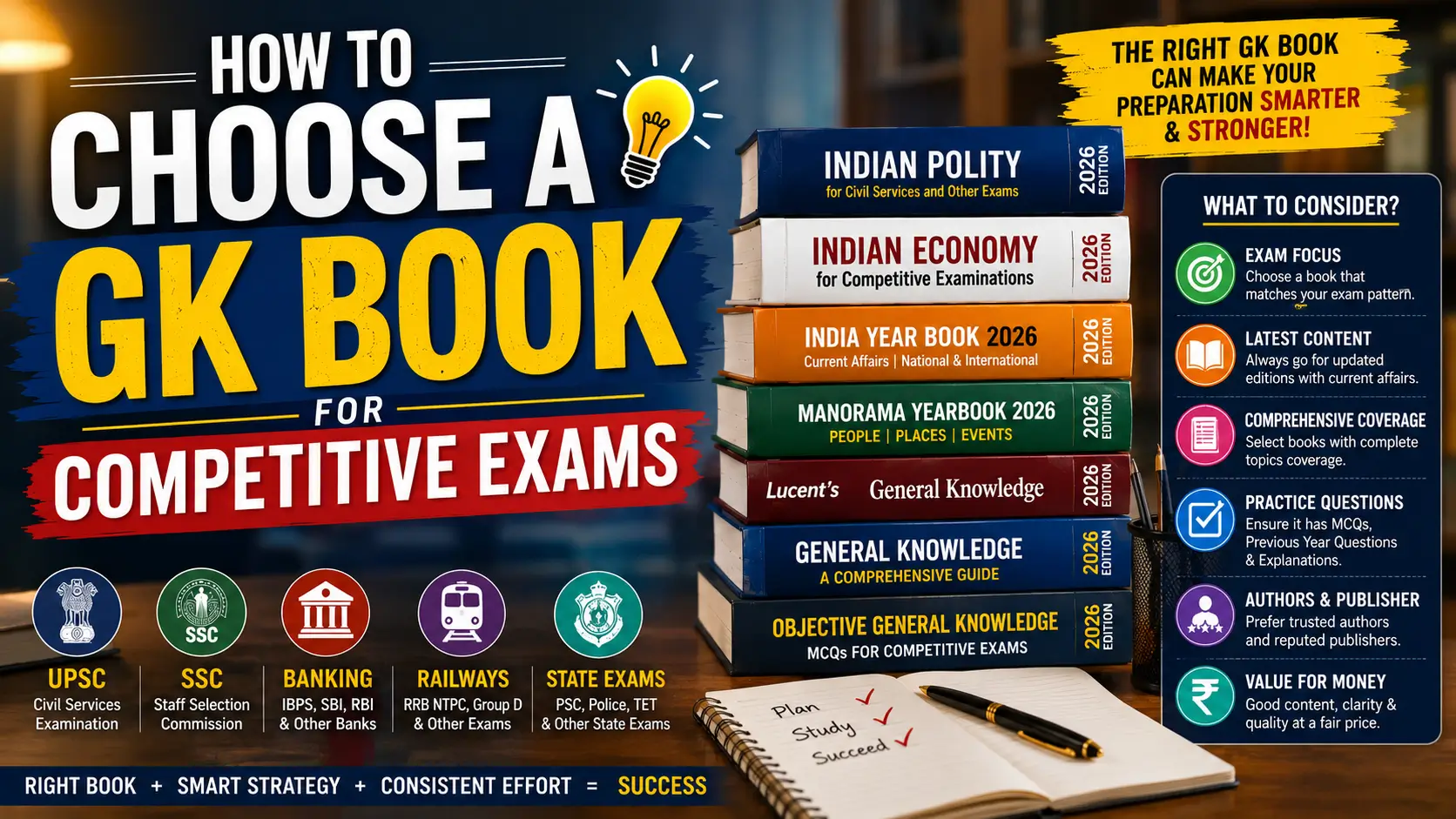
Before we get to the recommendations, understand this: there is no single best GK book for all exams. Different exams test different types of GK — and the best book for UPSC Prelims is not the same as what works for SBI PO.
Here's a quick framework to guide your choice:
Step 1 — Know your exam's GK split
| Exam | Static GK | Current Affairs | Banking Awareness |
|---|---|---|---|
| UPSC Prelims | 60–70% | 30–40% | — |
| SSC CGL | 70–80% | 20–30% | — |
| IBPS PO | 40–50% | 30–40% | 20–30% |
| SBI PO | 35–45% | 35–45% | 20–25% |
| RRB NTPC | 65–75% | 25–35% | — |
Step 2 — Match book type to exam type
- Heavy static GK → Lucent, Manorama Yearbook
- Current affairs heavy → Monthly magazines (Pratiyogita Darpan, Chronicle), annual yearbooks
- Banking awareness → Arihant Banking Awareness, Disha Banking GK
Step 3 — Don't buy more than 3 books. One static GK reference + one current affairs source + one exam-specific practice book is enough. More is not better.
Best GK Books for UPSC Prelims
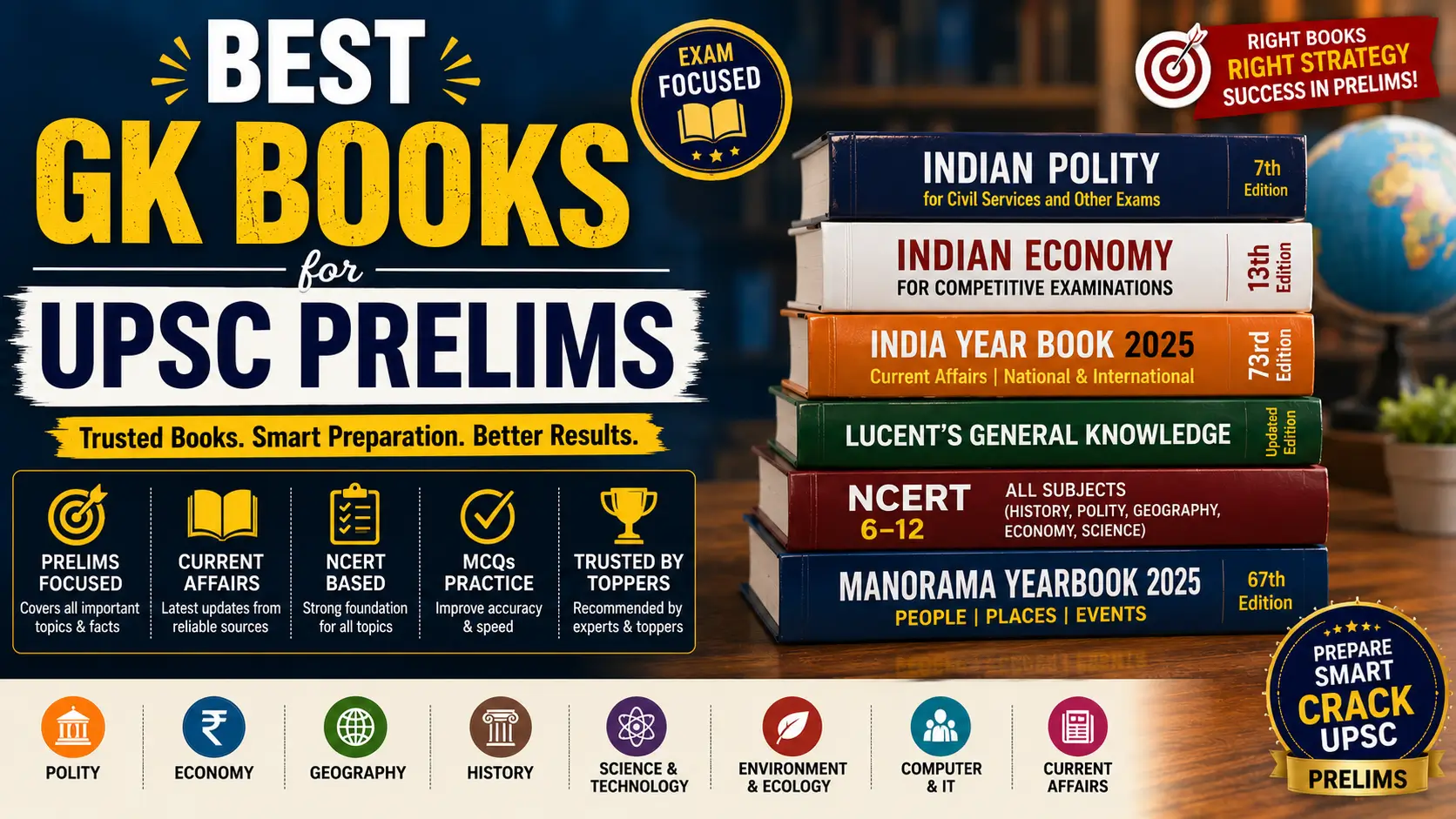
UPSC Prelims General Studies Paper 1 tests a wide range of GK — history, geography, polity, economy, environment, and science. The key is depth on certain topics, not just breadth.
1. NCERT Textbooks (Classes 6–12) — Foundation Must-Have
Best for: Building conceptual clarity before picking up any other GK book.
This is not a single book but a series, and it is non-negotiable for UPSC preparation. UPSC questions — particularly in history, geography, and polity — are deeply rooted in NCERT concepts.
- History: NCERT Class 6–8 (Ancient, Medieval), Class 10 (Modern India)
- Geography: NCERT Class 11 (Fundamental Physical Geography), Class 12 (India — People & Economy)
- Polity: NCERT Class 11 (Political Theory), Class 12 (Indian Constitution at Work)
- Economics: NCERT Class 11 (Indian Economic Development)
Coverage: Conceptual foundation across all GK categories. What it misses: Current affairs, recent data, banking awareness. Exam suitability: UPSC ✅ | SSC ✅ | Banking (partial) ✅
2. Laxmikanth — Indian Polity (M. Laxmikanth)
Best for: UPSC aspirants for whom Indian Polity is a high-yield subject.
This is the most-recommended polity book in every UPSC topper interview, and for good reason. It covers the Indian Constitution exhaustively — from fundamental rights to constitutional bodies to emergency provisions. UPSC regularly pulls 4–6 direct questions from this book's content.
- Chapters: 79 chapters covering the entire constitutional framework
- Depth: Goes beyond NCERT — covers amendments, landmark judgments, committee recommendations
- Language: Dense but structured — needs active reading with notes
Coverage: Indian polity, constitution, governance. What it misses: History, geography, economy, science. Exam suitability: UPSC ✅ | SSC CGL (high value) ✅ | Banking (moderate) ✅
3. India Yearbook (Publications Division, Govt. of India)
Best for: UPSC aspirants who need authoritative data on India's schemes, programmes, and economic indicators.
Published annually by the Government of India, this is the official data reference for UPSC preparation. Chapters cover agriculture, industry, transport, education, defence, foreign affairs, and more. UPSC frequently asks questions that are directly sourced from this book.
- Edition to buy: Always the most recent edition (2025–26 for 2026 exams)
- Weight: Heavy reading — best used as a reference, not cover-to-cover
- Pro tip: Focus on schemes and programmes chapters — these yield maximum questions
Coverage: India-specific static data, schemes, government programmes. What it misses: World GK, science, banking awareness. Exam suitability: UPSC ✅ | SSC (partial) ✅ | Banking (partial) ✅
4. Spectrum — A Brief History of Modern India (Rajiv Ahir)
Best for: UPSC aspirants who need modern Indian history covered thoroughly and quickly.
Modern Indian history accounts for a significant chunk of UPSC Prelims questions — the national movement, colonial policies, social reforms. Spectrum does this efficiently in under 500 pages.
- Coverage: 1757 to Independence — British policy, freedom movement, key personalities
- Style: Narrative but structured — easy to make notes
- Limitation: Does not cover ancient/medieval India
Coverage: Modern Indian history. What it misses: Ancient, medieval history (use NCERT for these). Exam suitability: UPSC ✅ | SSC CGL ✅
Best GK Books for SSC Exams
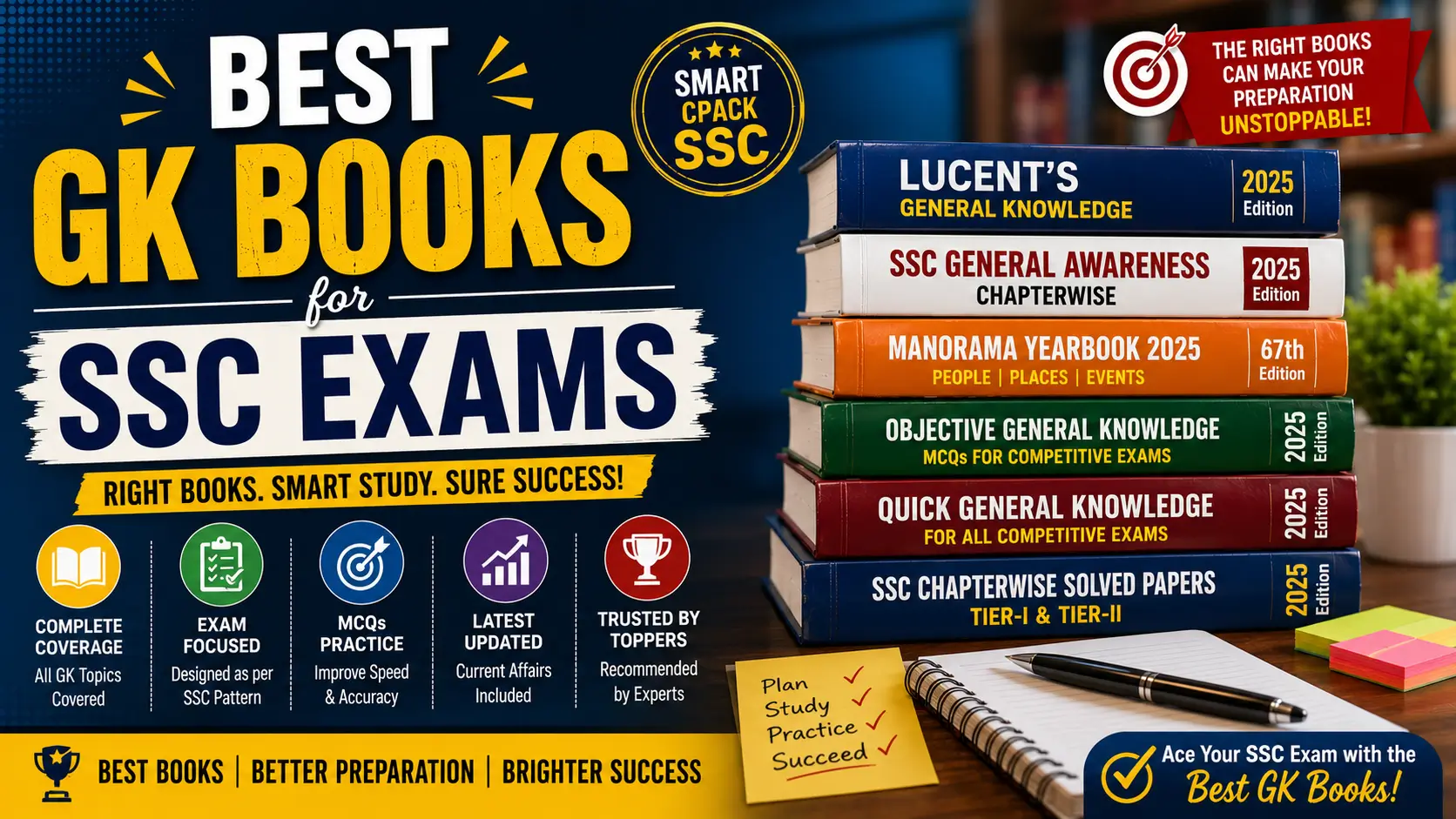
SSC exams — CGL, CHSL, MTS, CPO — test GK in a specific pattern. Questions tend to be direct, fact-based, and static in nature. Deep conceptual understanding matters less than wide coverage of facts.
5. Lucent's General Knowledge (Dr. Binay Karna)
Best for: SSC aspirants who need maximum static GK coverage in one volume.
Lucent is the most popular GK book in India for a reason — it covers an enormous range of topics: history, geography, polity, economy, science, sports, awards, and more, all in one 1,200+ page volume.
- Strengths: Wide coverage, affordable, trusted by millions
- Weakness: Some content is outdated and data accuracy is inconsistent in recent editions
- SSC relevance: Very high — SSC's static GK questions closely match Lucent's coverage areas
Our take: Lucent is still a valid choice for SSC in 2026, but you must supplement it with a current affairs source and verify any statistics before the exam.
Coverage: Static GK across all subjects. What it misses: Current affairs, banking awareness, recent data. Exam suitability: SSC ✅ | Railway ✅ | Banking (static GK portion) ✅ | UPSC (as a quick reference, not primary source) ⚠️
6. Arihant General Knowledge (Manohar Pandey)
Best for: SSC and Railway aspirants who want a more compact, updated alternative to Lucent.
Arihant's GK book is updated annually and tends to have more current data than Lucent. It is slightly less exhaustive but more readable, with practice questions at the end of each section.
- Strengths: Updated annually, practice questions, cleaner layout
- Weakness: Less comprehensive than Lucent for deep static GK
- SSC relevance: Good for CGL and CHSL — covers the breadth needed
Coverage: Static GK with practice questions. What it misses: Deep conceptual coverage. Exam suitability: SSC ✅ | Railway ✅ | Banking (partial) ✅
Best GK Books for Banking Exams

Banking exams (IBPS PO/Clerk, SBI PO/Clerk, RBI Grade B) have a unique GK composition: static GK + banking/financial awareness + current affairs. No single book covers all three. You need a combination.
7. Arihant Banking & Financial Awareness
Best for: Banking aspirants who need to build banking awareness from scratch.
This is the go-to reference for banking-specific GK — types of banks, RBI functions, monetary policy, financial inclusion, digital banking, and India's banking history. This content is largely absent from general GK books.
- Key chapters: RBI and its functions, types of bank accounts, credit instruments, budget & taxation, insurance
- Updated: Covers recent banking developments and schemes
- Practice questions: Yes — pattern-matched to IBPS and SBI exam questions
Coverage: Banking awareness, financial GK. What it misses: Static history, geography, science GK. Exam suitability: Banking ✅ | Insurance exams ✅
8. Manorama Yearbook (Malayala Manorama)
Best for: Aspirants who need a comprehensive annual current affairs + static GK reference in one book.
Published annually, Manorama Yearbook is a trusted companion for both UPSC and Banking aspirants. It covers the year's major events across politics, economy, science, sports, and international affairs, alongside a robust static GK section.
- Strengths: Well-organized, reliable data, covers both static and current
- Format: Encyclopaedic — works both as a cover-to-cover read and a quick reference
- Best used: Read cover-to-cover 6 months before exam, then use for revision
Coverage: Annual current affairs + static GK across all subjects. What it misses: Deep banking awareness, exam-specific practice questions. Exam suitability: UPSC ✅ | Banking ✅ | SSC ✅ | Railway ✅
9. Pratiyogita Darpan (Monthly Magazine)
Best for: All competitive exam aspirants who need to stay current with monthly affairs.
This is not a book but a monthly magazine — and it is the most widely read current affairs publication among Indian competitive exam aspirants. Each issue covers national and international current affairs, government schemes, sports, science, and more.
- Best practice: Read the current month's issue regularly; save special editions before exams
- Annual edition: Buy their yearly compilation for revision
- Language: Available in English and Hindi
Coverage: Monthly current affairs across all categories. What it misses: Deep static GK. Exam suitability: All exams ✅
Best GK Books for Railway Exams

RRB NTPC and Group D GK sections are primarily static in nature — similar to SSC but with specific emphasis on Indian geography, history, science, and railways-related GK.
10. Disha — Rapid General Knowledge 2026
Best for: Railway and SSC aspirants who need a compact, updated single-volume GK reference.
Disha's Rapid GK is updated annually and is particularly popular among Railway aspirants. It's more concise than Lucent but covers the key areas tested in RRB exams.
- Strengths: Compact format (around 350 pages), annual update, focused on exam-relevant content
- Railway-specific: Good coverage of Indian geography and railways history
- Practice questions: Yes — aligned to recent RRB question patterns
Coverage: Core static GK with exam-relevant focus. What it misses: In-depth coverage compared to Lucent. Exam suitability: Railway ✅ | SSC ✅ | Banking (static portion) ✅
Books That Work Across All Exams

Some books are genuinely versatile — they provide foundational knowledge that helps regardless of which exam you're targeting.
| Book | Best For | Why It Works Across Exams |
|---|---|---|
| NCERTs (6–12) | Foundation | All exams test NCERT concepts |
| Manorama Yearbook | Current affairs + static | Covers both; trusted for 50+ years |
| Pratiyogita Darpan | Monthly current affairs | Universal currency for all exam GK |
| Lucent GK | Static GK breadth | Coverage matches most exam patterns |
Quick Comparison Table
| Book | UPSC | SSC | Banking | Railway | Price (approx) |
|---|---|---|---|---|---|
| NCERTs (full set) | ⭐⭐⭐⭐⭐ | ⭐⭐⭐ | ⭐⭐ | ⭐⭐⭐ | Free (online) |
| Lucent GK | ⭐⭐ | ⭐⭐⭐⭐⭐ | ⭐⭐⭐ | ⭐⭐⭐⭐ | ₹250–350 |
| Manorama Yearbook | ⭐⭐⭐⭐ | ⭐⭐⭐ | ⭐⭐⭐⭐ | ⭐⭐⭐ | ₹250–300 |
| Laxmikanth Polity | ⭐⭐⭐⭐⭐ | ⭐⭐⭐⭐ | ⭐⭐⭐ | ⭐⭐ | ₹500–600 |
| Spectrum Modern India | ⭐⭐⭐⭐⭐ | ⭐⭐⭐⭐ | ⭐⭐ | ⭐⭐ | ₹350–450 |
| India Yearbook | ⭐⭐⭐⭐⭐ | ⭐⭐ | ⭐⭐⭐ | ⭐⭐ | ₹200–250 |
| Arihant Banking Awareness | ⭐ | ⭐ | ⭐⭐⭐⭐⭐ | ⭐ | ₹300–400 |
| Arihant General Knowledge | ⭐⭐ | ⭐⭐⭐⭐ | ⭐⭐⭐ | ⭐⭐⭐⭐ | ₹200–300 |
| Disha Rapid GK | ⭐⭐ | ⭐⭐⭐⭐ | ⭐⭐⭐ | ⭐⭐⭐⭐⭐ | ₹200–280 |
| Pratiyogita Darpan | ⭐⭐⭐⭐ | ⭐⭐⭐⭐ | ⭐⭐⭐⭐ | ⭐⭐⭐⭐ | ₹50–60/month |
Prices approximate as of 2026. Always check the latest edition when purchasing.
How to Build Your GK Book Stack
Don't try to read everything. Build a focused 3-book stack based on your exam:
For UPSC Prelims:
- NCERTs (foundation) → read once, make notes
- Laxmikanth Polity + Spectrum Modern India (subject depth) → read thoroughly
- Manorama Yearbook or India Yearbook (annual reference) → read 3 months before exam
For SSC CGL/CHSL:
- Lucent GK or Arihant GK (static GK base) → read and revise repeatedly
- Pratiyogita Darpan monthly issues (current affairs) → read as you go
- Previous year question papers (pattern practice) → solve 5 years' papers
For IBPS PO / SBI PO:
- Lucent or Arihant GK (static GK) → read key sections
- Arihant Banking & Financial Awareness (banking GK) → read thoroughly
- Pratiyogita Darpan + banking exam-specific current affairs capsules → last 6 months
For RRB NTPC / Group D:
- Disha Rapid GK (primary static reference) → read cover to cover
- Pratiyogita Darpan (current affairs) → monthly reading
- RRB previous year papers → solve 5–7 years' papers
Frequently Asked Questions (FAQs)
Which is the best GK book for competitive exams in India?
There is no single best book — it depends on your exam. For SSC, Lucent is the most trusted. For UPSC, NCERTs + Manorama Yearbook is the foundation. For Banking, combine a static GK book with Arihant Banking Awareness.
Is Lucent GK enough for SSC CGL?
Lucent covers the static GK portion well, but it is not enough on its own. You need a current affairs source (monthly magazine or annual digest) and practice questions from previous year papers alongside Lucent.
Can I use the same GK book for UPSC and SSC?
NCERTs and Manorama Yearbook work for both. However, UPSC needs deeper conceptual books (Laxmikanth, Spectrum), while SSC is better served by fact-heavy references like Lucent.
How many GK books should I buy?
Maximum 3. One static GK reference + one current affairs source + one exam-specific practice book. Buying more books and not finishing them is the single biggest mistake competitive exam aspirants make.
Which edition should I buy?
Always buy the most recent edition — especially for books that are updated annually (Manorama Yearbook, India Yearbook, Arihant GK, Disha Rapid GK). For NCERTs, the edition matters less since the content is stable.
Is Manorama Yearbook or India Yearbook better for UPSC?
Both serve different purposes. India Yearbook is the official government source — better for schemes, data, and India-specific statistics. Manorama Yearbook is more comprehensive for general current affairs. Many serious UPSC aspirants read both, but if you can only pick one, India Yearbook has stronger return on investment for Prelims.
What is the best GK book for beginners?
Start with NCERTs Classes 6–8 for History and Geography, and NCERT Class 11 for Polity. Once you've built a conceptual foundation, move to exam-specific books. Jumping into Lucent without this foundation makes retention very difficult.
Explore more GK resources, topic-wise notes, and exam preparation guides on GK2U.com.