
Engineering Mechanics – Section 1: Fundamentals, Force Systems, Equilibrium & MCQs


Engineering Mechanics – Section 1 covers the fundamental principles that form the foundation of mechanical and civil engineering studies. This section introduces key topics such as force systems, equilibrium, vectors, moments, couples, and the basic laws of motion. Students will learn how forces act on bodies and how engineering principles are applied to analyze static and dynamic systems. The content is designed for diploma, B.Tech, and competitive exam aspirants, providing clear explanations, essential formulas, solved examples, and practice questions. Mastering these concepts is crucial for understanding advanced engineering subjects and solving real-world engineering problems effectively.
1. According to the principle of conservation of energy, the total momentum of a system of masses in any direction remains constant unless acted upon by an external force in that direction.
A. True
B. False
Correct Answer: B. False
2. The friction experienced by a body, when in motion, is known as
A. rolling friction
B. dynamic friction
C. limiting friction
D. static friction
Correct Answer: B. dynamic friction
3. Two balls of equal mass and of perfectly elastic material are lying on the floor. One of the ball with velocity v is made to strike the second ball. Both the balls after impact will move with a velocity
A. v
B. v/2
C. v/4
D. v/8
Correct Answer: B. v/2
4. The term 'force' may be defined as an agent which produces or tends to produce, destroys or tends to destroy motion.
A. Agree
B. Disagree
Correct Answer: A. Agree
5. The coefficient of restitution for elastic bodies is one.
A. Correct
B. Incorrect
Correct Answer: B. Incorrect
Answer Explanation: The Coefficient of restitution for elastic bodies is 0 - 1.
The coefficient of restitution for perfect elastic bodies is 1.
6. The velocity ratio in case of an inclined plane inclined at angle θ to the horizontal and weight being pulled up the inclined plane by vertical effort is
A. sin θ
B. cos θ
C. tan θ
D. cosec θ
Correct Answer: A.sin θ
7. The range of projectile on a downward inclined plane is __________ the range on the upward inclined plane for the same velocity of projection and angle of projection.
A. less than
B. more than
C. equal to
Correct Answer: B. more than
8. The angle of inclination of a vehicle when moving along a circular path __________ upon its mass.
A. depends
B. does not depend
Correct Answer: B. does not depend
9. A body of weight W is required to move up on a rough inclined plane whose angle of inclination with the horizontal is α. The effort applied parallel to the plane is given by(where μ = tanφ = Coefficient of friction between the plane and the body.)
A. P = W tanα
B. P = W tan(α + φ)
C. P = W (sinα + μcosα)
D. P = W (cosα + μsinα)
Correct Answer: C. P = W (sinα + μcosα)
10. If the resultant of two equal forces have the same magnitude as either of the forces, then the angle between the two forces is
A. 30°
B. 60°
C. 90°
D. 120°
Correct Answer: D. 120°
11. A smooth cylinder lying on its convex surface remains in __________ equilibrium.
A. stable
B. unstable
C. neutral
Correct Answer: B. unstable
12. The coefficient of friction is the ratio of the limiting friction to the normal reaction between the two bodies.
A. Yes
B. No
Correct Answer: A. Yes
13. Moment of inertia of a circular section about an axis perpendicular to the section is
A. πd3/16
B. πd3/32
C. πd4/32
D. πd4/64
Correct Answer: C. πd4/32
14. The time of flight (t) of a projectile on an upward inclined plane is(where u = Velocity of projection, α = Angle of projection, and β = Inclination of the plane with the horizontal.)
A. \( t=\frac{g\cos\beta}{2u\sin(\alpha-\beta)} \)
B. \( t=\frac{2u\sin(\alpha-\beta)}{g\cos\beta} \)
C. \( t=\frac{g\cos\beta}{2u\sin(\alpha+\beta)} \)
D. \( t=\frac{2u\sin(\alpha+\beta)}{g\cos\beta} \)
Correct Answer: Option B
15. The unit of angular acceleration is
A. N-m
B. m/s
C. m/s2
D. rad/s2
Correct Answer: D. rad/s2
16. Moment of inertia of a triangular section of base (b) and height (h) about an axis passing through its C.G. and parallel to the base, is
A. bh3/4
B. bh3/8
C. bh3/12
D. bh3/36
Correct Answer: D. bh3/36
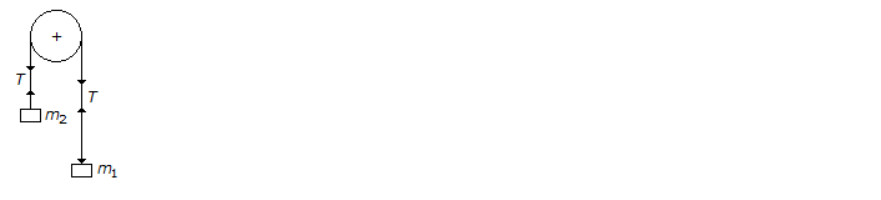
17. If the masses of both the bodies, as shown in the below figure, are reduced to 50 percent, then tension in the string will be
A. same
B. half
C. double
Correct Answer: B. half
18. Which of the following is an equation of linear motion? (where, u and v = Initial and final velocity of the body, a = Acceleration of the body, and s = Displacement of the body in time t seconds.)
A. v = u + a.t
B. s = u.t + 1/2 a.t2
C. v2 = u2+2a.s
D. all of these
Correct Answer: D. all of these
19. If a number of forces are acting at a point, their resultant will be inclined at an angle θ with the horizontal, such that
A. \( \tan\theta = \frac{\sum H}{\sum V} \)
B. \( \tan\theta = \frac{\sum V}{\sum H} \)
C. \( \tan\theta = \sum V \times \sum H \)
D. \( \tan\theta = \sqrt{\sum V + \sum H} \)
Correct Answer: B. tan θ = ∑V/∑H
20. The above figure shows the two equal forces at right angles acting at a point. The value of force R acting along their bisector and in opposite direction is
Correct Answer: C √2 P21. The force required to move the body up the plane will be minimum if it makes an angle with the inclined plane __________ the angle of friction.
A. equal to
B. less than
C. greater than
Correct Answer: A. equal to
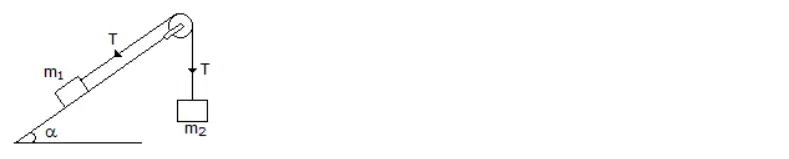
22. In the shown figure, if the angle of inclination of the plane is increased, then acceleration of the system will
A. increase
B. decrease
C. remain the same
Correct Answer: B. decrease
23. The total time taken by a projectile to reach maximum height and to return back to the ground, is known as time of flight.
A. Yes
B. No
Correct Answer: A. Yes
24. The frequency of oscillation of a torsional pendulum is
A. \( \frac{2nK}{r}\sqrt{\frac{g}{l}} \)
B. \( \frac{r}{2nK}\sqrt{\frac{l}{g}} \)
C. \( \frac{2\pi r}{K}\sqrt{\frac{g}{l}} \)
D. \( \frac{r}{2\pi K}\sqrt{\frac{g}{l}} \)
Correct Answer: Option D
25. The range of a projectile is maximum when the angle of projection is
A.30°
B.45°
C.60°
D.90°
Correct Answer: B.45°
26. The mechanical advantage of a lifting machine is the ratio of
A. distance moved by effort to the distance moved by load
B. load lifted to the effort applied
C. output to the input
D. all of the above
Correct Answer: B. load lifted to the effort applied
27. Static friction is always __________ dynamic friction.
A. equal to
B. less than
C. greater than
Correct Answer: C. greater than
28. A body will begin to move down an inclined plane if the angle of inclination of the plane is __________ the angle of friction.
A. equal to
B. less than
C. greater than
Correct Answer: C. greater than
29. When a particle moves along a circular path with uniform velocity, there will be no tangential acceleration.
A.Correct
B.Incorrect
Correct Answer: A.Correct
30. The bodies which rebound after impact are called
A. inelastic bodies
B. elastic bodies
C. neither elastic nor inelastic bodies
D. none of these
Correct Answer: B. elastic bodies
31. The maximum frictional force, which comes into play, when a body just begins to slide over the surface of the other body is known as
A. static friction
B. dynamic friction
C. limiting friction
D. coefficient of friction
Correct Answer: C. limiting friction
32. The center of gravity of an equilateral triangle with each side a is __________ from any of the three sides.
A. \( \frac{\sqrt{3}a}{2} \)
B. \( 2\sqrt{3}a \)
C. \( \frac{a}{2\sqrt{3}} \)
D. \( 3\sqrt{2}a \)
Correct Answer: Option C
33. The distance, between the point of projection and the point where the projectile strikes the ground, is known as range.
A. Correct
B. Incorrect
Correct Answer: A. Correct
34. The algebraic sum of the resolved parts of a number of forces in a given direction is equal to the resolved part of their resultant in the same direction. This is known as
A. principle of independence of forces
B. principle of resolution of forces
C. principle of transmissibility of forces
D. none of these
Correct Answer: B. principle of resolution of forces
35. The triangle law of forces states that if two forces acting simultaneously on a particle, be represented in magnitude and direction by the two sides of a triangle taken in order, then their resultant may be represented in magnitude and direction by the third side of a triangle, taken in opposite order.
A. True
B. False
Correct Answer: A. True
36. The angle between two forces when the resultant is maximum and minimum respectively are
A. 0° and 180°
B. 180° and 0°
C. 90° and 180°
D. 90° and 0°
Correct Answer: A. 0° and 180°
37. The path of the projectile is a parabola.
A. True
B. False
Correct Answer: A. True
38. The equivalent length of a simple pendulum which gives the same frequency as compound pendulum is
A. \( \frac{h}{kG^{2}+h^{2}} \)
B. \( \frac{kG^{2}+h^{2}}{h} \)
C. \( \frac{h^{2}}{kG^{2}+h^{2}} \)
D. \( \frac{kG^{2}+h^{2}}{h^{2}} \)
Correct Answer: Option B
39. A redundant frame is also called __________ frame.
A. perfect
B. imperfect
C. deficient
Correct Answer: B. imperfect
40. Mass moment of inertia of a uniform thin rod of mass M and length (l) about its mid-point and perpendicular to its length is
A. \( \frac{2}{3}Ml^{2} \)
B. \( \frac{1}{3}Ml^{2} \)
C. \( \frac{3}{4}Ml^{2} \)
D. \( \frac{1}{12}Ml^{2} \)
Correct Answer: Option D
41. A resultant force is a single force which produces the same effect as produced by all the given forces acting on a body.
A. True
B. False
Correct Answer: A. True
42. When a rigid body is suspended vertically, and it oscillates with a small amplitude under the action of the force of gravity, the body is known as
A. simple pendulum
B. compound pendulum
C. torsional pendulum
D. second's pendulum
Correct Answer: B. compound pendulum
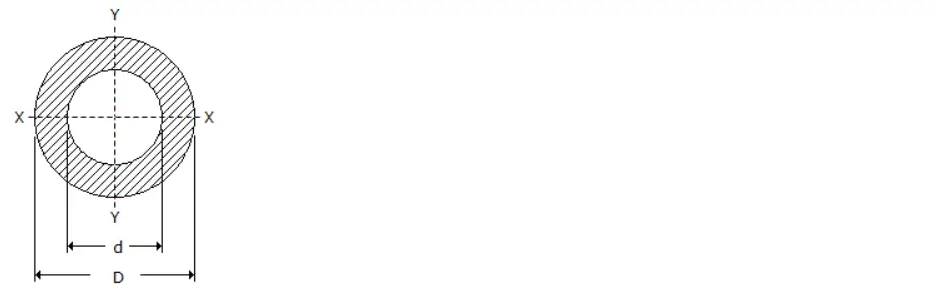
43. Moment of inertia of a hollow circular section, as shown in the below figure about X-axis, is
A. \( \frac{\pi}{16}(D^{2}-d^{2}) \)
B. \( \frac{\pi}{16}(D^{3}-d^{3}) \)
C. \( \frac{\pi}{32}(D^{4}-d^{4}) \)
D. \( \frac{\pi}{64}(D^{4}-d^{4}) \)
Correct Answer: Option D
44. If two blocks of equal mass are attached to the two ends of a light string and one of the blocks is placed over a smooth horizontal plane while the other is hung freely after passing over a smooth pulley, then the two blocks will have some motion.
A. Agree
B. Disagree
Correct Answer: A. Agree
45. During elastic impact, the relative velocity of the two bodies after impact is __________ the relative velocity of the two bodies before impact.
A. equal to
B. equal and opposite to
C. less than
D. greater than
Correct Answer: B. equal and opposite to
46. Work done is said to be zero, when
A. some force acts on a body, but displacement is zero
B. no force acts on a body but some displacement takes place
C. either (a) or (b)
D. none of the above
Correct Answer: C. either (a) or (b)
47. The force which acts along the radius of a circle and directed away from the center of the circle is called centrifugal force.
A. Agree
B. Disagree
Correct Answer: A. Agree
48. One watt is equal to
A. 0.1 joule/s
B. 1 joule/s
C. 10 joules/s
D. 100 joules/s
Correct Answer: B. 1 joule/s
49. two like parallel forces are acting at a distance of 24 mm apart and their resultant is 20 N. It the line of action of the resultant is 6 mm from any given force, the two forces are
A. 15 N and 5 N
B. 20 N and 5 N
C. 15 N and 15 N
D. none of these
Correct Answer: A. 15 N and 5 N
50. If two bodies having masses m1 and m2 (m1>m2) have equal kinetic energies, the momentum of the body having mass m1 is __________ the momentum of the body having mass m2
.
A. equal to
B. less than
C. greater than
Correct Answer: C. greater than