
Engineering Mechanics – Section 2: Fundamentals, Force Systems, Equilibrium & MCQs

Prepare for your engineering examinations with Engineering Mechanics Section 2 MCQ Questions and Answers with Solutions. This section covers important concepts of engineering mechanics through carefully selected multiple-choice questions designed for diploma, B.Tech, polytechnic, ITI, and competitive engineering exams.
Practice objective-type questions on topics such as force systems, equilibrium, friction, centroids, moments, motion, and other fundamental engineering mechanics concepts. Each question includes the correct answer to help students improve their understanding, accuracy, and problem-solving skills.
Whether you are preparing for semester exams, technical recruitment tests, SSC JE, RRB JE, GATE foundation topics, or other engineering entrance examinations, these Engineering Mechanics MCQs will help strengthen your conceptual knowledge and boost confidence.
Regular practice of these questions can improve speed, enhance exam performance, and identify areas that require additional study. Start solving Engineering Mechanics Section 2 MCQs today and take your exam preparation to the next level.
1. The point, through which the whole weight of the body acts, irrespective of its position, is known as
A. moment of inertia
B. center of gravity
C. center of percussion
D. center of mass
Correct Answer: B. center of gravity
2. The loss of kinetic energy during the elastic impact is zero.
A. Agree
B. Disagree
Correct Answer: A. Agree
3. The overturning of a vehicle on a level circular path can be avoided if the velocity of the vehicle is __________ \( \frac{\sqrt{g\,r\,a}}{h} \)
A. less than
B. greater than
Correct Answer: A. less than
4. Which of the following is a scalar quantity?
A. Force
B. Speed
C. Velocity
D. Acceleration
Correct Answer: B. Speed
5. The rate of change of momentum is directly proportional to the impressed force and takes place in the same direction in which the force acts. This statement is known as
A. Newton's first law of motion
B. Newton's second law of motion
C. Newton's third law of motion
D. none of these
Correct Answer: B. Newton's second law of motion
6. In ideal machines, mechanical advantage is __________ velocity ratio.
A. equal to
B. less than
C. greater than
Correct Answer: A. equal to
7. The minimum force required to slide a body of weight W on a rough horizontal plane is
A. W sin θ
B. W cos θ
C. W tan θ
D. none of these
Correct Answer: C. W tan θ
8. The moment of inertia of a square of side a about its diagonal is
A. a2/8
B. a3/12
C. a4/12
D. a4/16
Correct Answer: C. a4/12
9. The angular velocity (in rad / s) of a body rotating at N revolutions per minute is
A. πN/60
B. πN/180
C. 2πN/60
D. 2πN/180
Correct Answer: C. 2πN/60
10. The maximum efficiency of a lifting machine is
A. 1/m
B. V.R./m
C. m/V.R.
D. 1/(m x V.R.)
Correct Answer: D. 1/(m x V.R.)
11. The center of gravity of a semi-circle lies at a distance of __________ from its base measured along the vertical radius.
A. 3r/ 8
B. 4r/ 3π
C. 8r/3
D. 3r/4π
Correct Answer: B. 4r/ 3π
12. The process of finding out the resultant force is called __________ of forces.
A. composition
B. resolution
Correct Answer: A. composition
13. A weight of 1000 N can be lifted by an effort of 80 N. If the velocity ratio is 20, the machine is
A. reversible
B. non-reversible
C. ideal
Correct Answer: A. reversible
14. In a framed structure, as shown in the below figure, the force in the member BC is
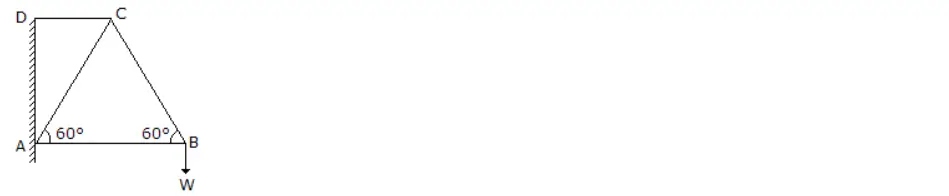
A. \( \frac{W}{\sqrt{3}} \) (compression)
B. \( \frac{W}{\sqrt{3}} \) (tension)
C. \( \frac{2W}{\sqrt{3}} \) (compression)
D. \( \frac{2W}{\sqrt{3}} \) (tension)
Correct Answer: Option D
15. The potential energy of a vertically raised body is __________ the kinetic energy of a vertically falling body.
A. equal to
B. less than
C. greater than
Correct Answer: A. equal to
16. If a number of forces acting at a point be represented in magnitude and direction by the three sides of a triangle, taken in order, then the forces are not in equilibrium.
A. Agree
B. Disagree
Correct Answer: B. Disagree
17. The periodic time of a particle with simple harmonic motion is __________ proportional to the angular velocity.
A. directly
B. inversely
Correct Answer: B. inversely
18. The motion of a particle around a fixed axis is
A. translatory
B. rotary
C. circular
D. translatory as well as rotary
Correct Answer: C. circular
19. A block of mass m1, placed on an inclined smooth plane is connected by a light string passing over a smooth pulley to mass m2, which moves vertically downwards as shown in the below figure. The tension in the string is

Correct Answer: Option D
20. If a given force (or a given system of forces) acting on a body __________ the position of the body, but keeps it in equilibrium, then its effect is to produce internal stress in the body.
A. change
B. does not change
Correct Answer: B. does not change
21. The principle of transmissibility of forces states that, when a force acts upon a body, its effect is
A. same at every point on its line of action
B. different at different points on its line of action
C. minimum, if it acts at the center of gravity of the body
D. maximum, if it acts at the center of gravity of the body
Correct Answer: C. minimum, if it acts at the center of gravity of the body
22. A differential pulley block has larger and smaller diameters of 100 mm and 80 mm respectively. Its velocity ratio is
A. 5
B. 10
C. 20
D. 40
Correct Answer: B. 10
23. If three forces acting at a point are represented in magnitude and direction by the three sides of a triangle, taken in order, then the forces are in equilibrium
A. Yes
B. No
Correct Answer: A. Yes
24. Newton's second law motion __________ a relation between force and mass of a moving body.
A. gives
B. does not give
Correct Answer: A. gives
25. The periodic time of one oscillation for a simple pendulum is(where l = Length of the pendulum.)
Correct Answer: Option C
26. The resultant of two forces P and Q acting at an angle θ is
Correct Answer: Option B
27. Which of the following are vector quantities?
A. Linear displacement
B. Linear velocity
C. Linear acceleration
D. all of these
Correct Answer: D. all of these
28. The maximum acceleration of a particle moving with simple harmonic motion is
A. ω
B. ωr
C. ω2r
D. ω/r
Correct Answer: C. ω2r
29. A lift moves downwards with an acceleration of 9.8 m/s2. The pressure exerted by a man on the floor of the lift is zero.
A.True
B.False
Correct Answer: A.True
30. Non-coplanar concurrent forces are those forces which
A. meet at one point, but their lines of action do not lie on the same plane
B. does not meet at one point and their lines of action do not lie on the same plane
C. meet at one point and their lines of action also lie on the same plane
D. does not meet at one point, but their lines of action lie on the same plane
Correct Answer: A. meet at one point, but their lines of action do not lie on the same plane
31. Which of the following statement is correct?
A. The kinetic energy of a body during impact remains constant.
B. The kinetic energy of a body before impact is equal to the kinetic energy of a body after impact.
C. The kinetic energy of a body before impact is less than the kinetic energy of a body after impact.
D. The kinetic energy of a body before impact is more than the kinetic energy of a body after impact.
Correct Answer: D. The kinetic energy of a body before impact is more than the kinetic energy of a body after impact.
32. The maximum efficiency of a screw jack is
Correct Answer: Option A
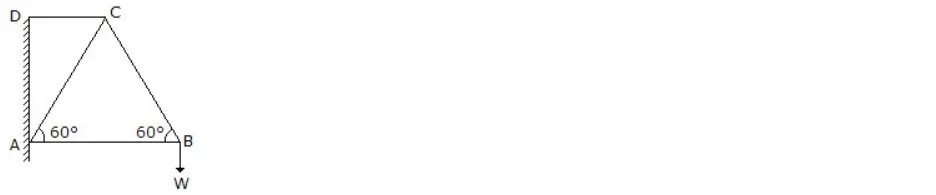
33. In a framed structure, as shown in the below figure, the force in the member AC is numerically equal to the force in member BC.
A. Correct
B. Incorrect
Correct Answer: A. Correct
34. The force which acts along the radius of a circle and directed towards the center of the circle is known as centripetal force.
A. True
B. False
Correct Answer: A. True
35. Moment of inertia of a triangular section of the base (b) and height (h) about an axis through its base, is
A. bh3/4
B. bh3/8
C. bh3/ 12
D. bh3/ 36
Correct Answer: C. bh3/ 12
36. Concurrent forces are those forces whose lines of action
A. lie on the same line
B. meet at one point
C. meet on the same plane
D. none of these
Correct Answer: B. meet at one point
37. The tension in the cable supporting a lift is more when the lift is moving __________ with an acceleration.
A. upwards
B. downwards
Correct Answer: A. upwards
38. According to the law of moments, if a number of coplanar forces acting on a particle are in equilibrium, then
A. their algebraic sum is zero
B. their lines of action are at equal distances
C. the algebraic sum of their moments about any point in their plane is zero
D. the algebraic sum of their moments about any point is equal to the moment of their resultant force about the same point.
Correct Answer: C. the algebraic sum of their moments about any point in their plane is zero
39. If u1 and u2 are the velocities of two moving bodies in the same direction before impact and v1 and v2 are their velocities after impact, then the coefficient of restitution is given by
Correct Answer: Option B
40. Two bodies of masses m1 and m2 are hung from the ends of a rope, passing over a frictionless pulley as shown in the figure below. The acceleration of the string will be

Correct Answer: Option A
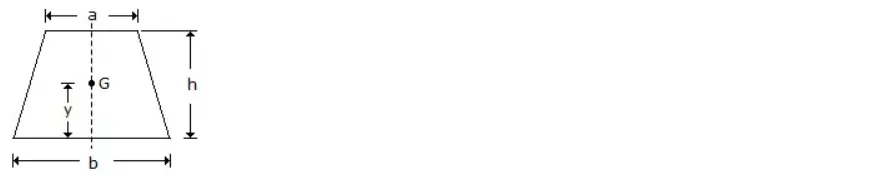
41. The center of gravity of a trapezium with parallel sides a and b lies at a distance of y from the base b, as shown in the below figure. The value of y is
Correct Answer: Option C
42. A machine having an efficiency of less than 50%, is known as
A. reversible machine
B. non-reversible machine
C. neither reversible nor non-reversible machine
D. ideal machine
Correct Answer: B. non-reversible machine
43. The total momentum of a system of masses (i. e. moving bodies) in any one direction remains constant unless acted upon by an external force in that direction. This statement is called
A. Newton's first law of motion
B. Newton's second law of motion
C. principle of conservation of energy
D. principle of conservation of momentum
Correct Answer: D. principle of conservation of momentum
44. The velocity ratio of a differential pulley block with D and d as the diameters of larger and smaller pulley is
Correct Answer: Option C
45. The unit of mass moment of inertia in S.I. units is kg-m2
.
A. True
B. False
Correct Answer: A. True
46. The center of gravity of an isosceles triangle with base (p) and sides (q) from its base is
Correct Answer: Option A
47. A newton is defined as the force while acting upon a mass of one kg, produces an acceleration of 1 m / s2 in the direction of which it acts.
A. Yes
B. No
Correct Answer: A. Yes
48. The acceleration of a particle moving with simple harmonic motion, at any instant is given by
A. ω.y
B. ω2.y
C. ω2 /y
D. ω3.y
Correct Answer: B. ω2.y
49. The skidding away of the vehicle on a level circular path can be avoided if the force of friction between the wheels and the ground is __________ the centrifugal force.
A. less than
B. greater than
Correct Answer: B. greater than