
Engineering Mechanics – Section 4: Fundamentals, Force Systems, Equilibrium & MCQs | Complete Study Notes

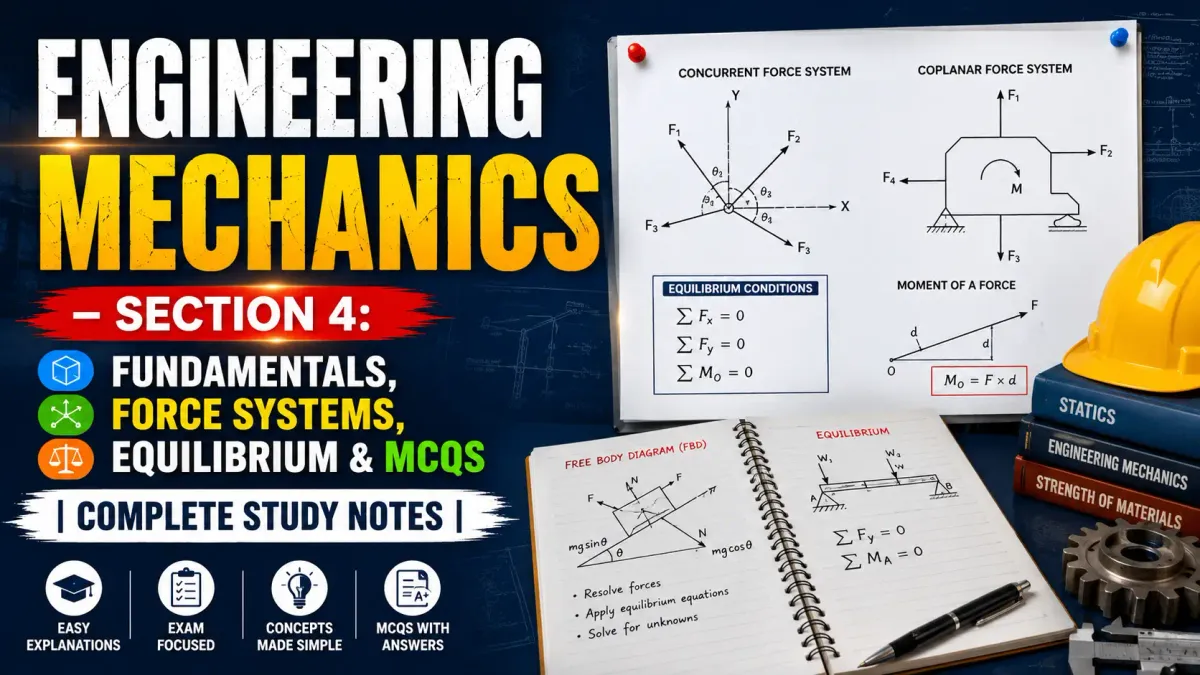
Engineering Mechanics – Section 4: Fundamentals, Force Systems, Equilibrium & MCQs is a complete study resource designed for engineering students, diploma learners, and candidates preparing for competitive technical examinations. This section explains the fundamental concepts of engineering mechanics, including force systems, vector representation of forces, moments, couples, equilibrium conditions, free body diagrams (FBD), and the analysis of coplanar force systems in a clear and easy-to-understand manner.
Whether you are studying for university semester exams, GATE, SSC JE, RRB JE, or other engineering recruitment exams, these notes provide a structured learning approach supported by carefully selected multiple-choice questions (MCQs) with answers to strengthen conceptual understanding and problem-solving skills. Each topic is presented with concise explanations, practical examples, and exam-focused insights to help learners build a strong foundation in statics and mechanics.
This Engineering Mechanics Section 4 guide is ideal for mechanical, civil, electrical, and production engineering students who want to revise key concepts quickly while improving accuracy in objective examinations. By practicing the included MCQs and reviewing essential formulas, students can enhance their confidence and perform better in both academic assessments and competitive engineering exams. Start learning today and master the core principles of Engineering Mechanics with confidence.
1. Three forces acting on a rigid body are represented in magnitude, direction and line of action by the three sides of a triangle taken in order. The forces are equivalent to a couple whose moment is equal to
A. area of the triangle
B. twice the area of the triangle
C. half the area of the triangle
D. none of these
Correct Answer: B. twice the area of the triangle
2. If the tension in the cable supporting a lift moving downwards is half the tension when it is moving upwards, the acceleration of the lift is
A. g/2
B. g/3
C. g/4
D. none of these
Correct Answer: D. none of these
3. The efficiency of a screw jack is given by(where α = Helix angle, and φ = Angle of friction.)
A. \( \frac{\tan(\alpha+\phi)}{\tan\alpha} \)
B. \( \frac{\tan\alpha}{\tan(\alpha+\phi)} \)
C. \( \frac{\tan(\alpha-\phi)}{\tan\alpha} \)
D. \( \frac{\tan\alpha}{\tan(\alpha-\phi)} \)
Correct Answer: Option B
4. When a train is rounding a curve, the side thrust on the wheel flanges is prevented by raising the outer edge of the rail.
A. Yes
B. No
Correct Answer: A. Yes
5. The frequency of vibrations means the number of cycles per second.
A. Yes
B. No
Correct Answer: A. Yes
6. The time of flight (t) of a projectile on a horizontal plane is given by
A. \( t = \frac{2u\sin\alpha}{g} \)
B. \( t = \frac{2u\cos\alpha}{g} \)
C. \( t = \frac{2u\tan\alpha}{g} \)
D. \( t = \frac{2u}{g\sin\alpha} \)
Correct Answer: Option A
7. The velocity ratio for the third system of pulleys is
A. n
B. n2
C. 2n
D. 2n - 1
Correct Answer: D. 2n - 1
8. If the gravitational acceleration at any place is doubled, then the weight of a body will be
A. \(\frac{g}{2}\)
B. \(g\)
C. \(\sqrt{2}\,g\)
D. \(2g\)
Correct Answer: D. 2g
9. The moment of inertia of a thin spherical shell of mass m and radius r, about its diameter, is
A. mr2/3
B. 2mr2/3
C. 2mr2/5
D. 3mr2/5
Correct Answer: B. 2mr2/3
10. The resultant of two forces P and Q (such that P > Q) acting along the same straight line, but in opposite direction, is given by
A. P + Q
B. P - Q
C. P / Q
D. Q / P
Correct Answer: B. P - Q
11. The velocity ratio for the second system of pulleys is n.
A. True
B. False
Correct Answer: A. True
12. The law of motion involved in the recoil of the gun is
A. Newton's first law of motion
B. Newton's second law of motion
C. Newton's third law of motion
D. none of these
Correct Answer: C. Newton's third law of motion
13. When a particle moves along a circular path, its acceleration has two components, one is normal component and the other is tangential component of acceleration.
A. True
B. False
Correct Answer: A. True
14. A machine which is not capable of doing any work in the reversed direction, after the effort is removed, is called a reversible machine.
A. True
B. False
Correct Answer: B. False
15. The range of projectile will be maximum for a given velocity of the projectile when the angle of projection (α) is
A. β/2
B. 30° + β/2
C. 45° + β/2
D. 60° + β/2
Correct Answer: C. 45° + β/2
16. When two elastic bodies collide with each other,
A. the two bodies will momentarily come to rest after the collision
B. the two bodies tend to compress and deform at the surface of the contact
C. the two bodies begin to regain their original shape
D. all of the above
Correct Answer: D. all of the above
17. The centre of gravity of a triangle lies at a point where its medians intersect each other.
A. True
B. False
Correct Answer: A. True
18. In order to double the period of simple pendulum, the length of the string should be
A. halved
B. doubled
C. quadrupled
Correct Answer: C. quadrupled
19. The moment of inertia of a square of side an about its base is a4/ 3
A. True
B. False
Correct Answer: A. True
20. If the number of pulleys in a system is equal to its velocity ratio, then it is a __________ system of pulleys
A. first
B. second
C. third
Correct Answer: B. second
21. The centre of gravity of a right angled triangle lies at its geometrical centre.
A. Correct
B. Incorrect
Correct Answer: B. Incorrect
22. Vectors method for the resultant force is also called polygon law of forces.
A. Correct
B. Incorrect
Correct Answer: A. Correct
23. Two equal and opposite parallel forces whose lines of action are different form a couple.
A. Correct
B. Incorrect
Correct Answer: A. Correct
24. When a person, on a bicycle, drives round a curve, he has to lean __________ to maintain equilibrium.
A. inward
B. outward
Correct Answer: A. inward
25. A circular hole of 50 mm diameter is cut out from a circular disc of 100 mm diameter as shown in the below figure. The centre of gravity of the section will lie

A. in the shaded area
B. in the hole
C. at O
Correct Answer: A. in the shaded area
26. The maximum velocity of a particle moving with simple harmonic motion is
A. ω
B. ωr
C. ω2r
D. ω/r
Correct Answer: B. ωr
27. The loss of kinetic energy due to the direct impact of two bodies __________ upon the value of the coefficient of restitution.
A. depends
B. does not depend
Correct Answer: A. depends
28. A body of mass m moving with a constant velocity v strikes another body of same mass m moving with the same velocity but in opposite direction. The common velocity of both the bodies after the collision is
A. v
B. 2v
C. 4v
D. 8v
Correct Answer: B. 2v
29. Moment of inertia of a rectangular section having width (b) and depth (d) about an axis passing through its C.G. and parallel to the width (b), is
A. \(\frac{db^3}{12}\)
B. \(\frac{bd^3}{12}\)
C. \(\frac{db^3}{36}\)
D. \(\frac{bd^3}{36}\)
Correct Answer: Option B
30. The unit of power in S.I. units is
A. horsepower
B. joule
C. Watt
D. kg-m
Correct Answer: C. Watt
31. According to parallel axis theorem, the moment of inertia of a section about an axis parallel to the axis through centre of gravity (i.e. IP) is given by(where, A = Area of the section, IG = Moment of inertia of the section about an axis passing through its C.G., and h = Distance between C.G. and the parallel axis.)
A. IP = IG + Ah2
B. IP = IG - Ah2
C. IP = IG / Ah2
D. IP = Ah2 / IG
Correct Answer: A. IP = IG + Ah2
32. The resultant of two equal forces P making an angle θ is given by
A. 2 P sin θ /2
B. 2 P cos θ /2
C. 2 P tan θ /2
D. 2 P cot θ /2
Correct Answer: B. 2 P cos θ /2
33. The force, by which the body is attracted, towards the centre of the earth, is called
A. impulsive force
B. mass
C. weight
D. momentum
Correct Answer: C. weight
34. Coplanar concurrent forces are those forces which
A. meet at one point, but their lines of action do not lie on the same plane
B. do not meet at one point and their lines of action do not lie on the same plane
C. meet at one point and their lines of action also lie on the same plane
D. do not meet at one point, but their lines of action lie on the same plane
Correct Answer: C. meet at one point and their lines of action also lie on the same plane
35. The power developed by a body acted upon by a torque T newton meter (N - m) and revolving at ω radian/s is given by
A. T.ω (in watts)
B. T.ω/60 (in watts)
C. T.ω/75 (in kilowatts)
D. T.ω/4500 (in kilowatts)
Correct Answer: A. T.ω (in watts)
36. The time taken by a particle for one complete oscillation is known as periodic time.
A. Agree
B. Disagree
Correct Answer: A. Agree
37. The velocity ratio of a first system of pulleys with 4 pulleys is
A. 4
B. 8
C. 16
D. 20
Correct Answer: C. 16
38. One joule means that
A. work is done by a force of 1 N when it displaces a body through 1m
B. work is done by a force of 1 kg when it displaces a body through 1 m
C. work is done by a force of 1 dyne when it displaces a body through 1 cm
D. work is done by a force of 1 g when it displaces a body through 1 cm
Correct Answer: A. work is done by a force of 1 N when it displaces a body through 1m
39. The moment of inertia of a sphere of mass m and radius r, about an axis tangential to it, is
A. 2mr2/3
B. 2mr2/5
C. 7mr2/3
D. 7mr2/5
Correct Answer: D. 7mr2/5
40. The velocity ratio for the first system of pulleys is(where n is the number of pulleys.)
A. n
B. n2
C. 2n
D. 2n - 1
Correct Answer: C. 2n
41. The ideal angle of banking provided on the curves on roads depends upon
A. weight of the vehicle
B. (velocity)2 of the vehicle
C. nature of the road surface
D. coefficient of friction between the road and vehicle contact point
Correct Answer: B. (velocity)2 of the vehicle
42. If a pendulum is taken 1 km below the earth surface in a mine, it will __________ in time.
A. gain
B. lose
Correct Answer: B. loose
43. The moment of inertia of a thin disc of mass m and radius r, about an axis through its centre of gravity and perpendicular to the plane of the disc is
A. mr2/2
B. mr2/4
C. mr2/6
D. mr2/8
Correct Answer: A. mr2/2
44. The linear velocity of a body rotating at ω rad / s along a circular path of radius r is given by
A. ω/r
B. ω.r
C. ω2/r
D. ω2.r
Correct Answer: B. ω.r
45. A machine which is capable of doing work in the reversed direction, after the effort is removed, is called a non-reversible machine.
A. Yes
B. No
Correct Answer: B. No
46. The forces which do not meet at one point and their lines of action do not lie on the same plane are known as
A. coplanar concurrent forces
B. coplanar non-concurrent forces
C. non-coplanar concurrent forces
D. none of these
Correct Answer: D. none of these
47. A non-reversible machine is also called a self-locking machine.
A. Agree
B. Disagree
Correct Answer: A. Agree
48. Mass moment of inertia of a thin rod about its one end is __________ the mass moment of inertia of the same rod about its mid-point
A. same as
B. twice
C. thrice
D. four times
Correct Answer: D. four times
49. Moment of inertia of a hollow rectangular section as shown in the below figure about Y-Y axis is not the same as that about X-X axis.

A. Yes
B. No
Correct Answer: A. Yes
50. The angle of the inclined plane at which a body just begins to slide down the plane is called helix angle.
A. True
B. False
Correct Answer: B. False