Indian Arts & Culture GK Questions and Answers for Competitive Exams (MCQs)

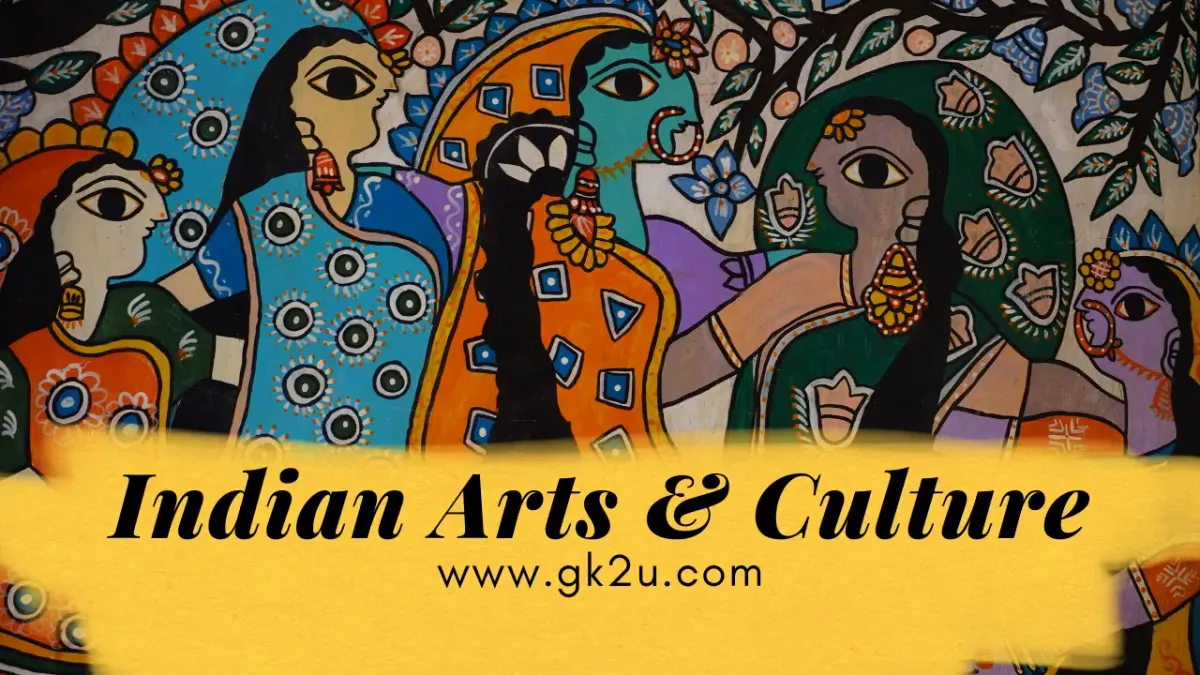
Explore a comprehensive collection of Indian Arts & Culture GK questions and answers designed for competitive exam preparation. This page covers important topics from Indian art, culture, heritage, architecture, classical dances, music, festivals, literature, and traditions, making it highly useful for exams like UPSC, APSC, SSC, ADRE, Assam Police, and other government job tests.
All questions are presented in an easy-to-understand MCQ (Multiple Choice Questions) format with accurate answers, helping students quickly revise key concepts of Indian culture and history. Whether you are a beginner or an advanced learner, this resource will strengthen your knowledge of India’s rich cultural heritage and artistic diversity.
The content is regularly updated with latest exam-oriented questions, ensuring you stay ahead in your preparation. It is also ideal for school students, quiz competitions, and general knowledge improvement.
By practicing these Indian Art and Culture questions, you can improve your accuracy, boost confidence, and score higher in competitive exams. Bookmark this page for daily revision and stay consistent in your preparation journey.
1. Castle Naggar heritage site is located in __:
(A) Himachal Pradesh
(B) Punjab
(C) Odisha
(D) Haryana
Correct Answer: (A) Himachal Pradesh
2. Which among the following Kings built the Kailashnath Temple of Ellora?
(A) Rashtrakuta king Krishna I
(B) Narasimhavarman II
(C) Rashtrakuta king Krishna II
(D) None of the above
Correct Answer: (A) Rashtrakuta king Krishna I
Answer Explanation:
Rashtrakuta king, krishna-1 had built the Kailash temple of Ellora. It is considered as the wonder of rock-out architecture. Kailasanath Temple is a famous temple, one of the 34 monasteries and temples, known collectively as the Ellora Caves, extending over more than 2 km, that were dug side by side in the wall of a high basalt cliff in the complex located at Ellora, Maharashtra, India.
3. Who among the following got the Mahabharata translated into Persian and named it as ‘Razmnameh’?
(A) Akbar
(B) Jahangir
(C) Aurangzeb
(D) None of the above
Correct Answer: (A) Akbar
Answer Explanation:
The Mahabharata was translated into Persian at Akbar’s orders, by Faizi and `Abd al-Qadir Bada’uni (c. 1540 – 1615) and named Razmnameh.
4. Among the five monolithic rathas of Pallavas at Mahabalipuram, the largest is ___?
(A) Arjuna
(B) Bhima
(C) Dharmaraja
(D) Draupadi
Correct Answer: (C) Dharmaraja
Answer Explanation:
Mahabalipuram Temples: Pallava dynasty: The five monolithic rathas are square or oblong in plan, pyramidal in elevation and varying in their overall dimensions. the Dharmaraja Ratha constructed in Pallava style is the largest of all, having huge pillats in the portico with statue of lions, pyramidal tower and turret roof.
5. Sayana, an important commentator on Vedas was associated with which among the following empires?
(A) Chola Empire
(B) Vijayanagar Empire
(C) Hoyasala Empire
(D) Bahmani Empire
Correct Answer: (B) Vijayanagar Empire
Answer Explanation:
Sayana: was an important commentator on the Vedas. His commentary on the Rigveda was edited by Max Müller, 1849-1875. He flourished under king Bukka I and his successor Harihara II in the Vijayanagar Empire of South India.
6. In which century, the Rajatarangini of Kalhana was composed?
(A) 10th
(B) 11th
(C) 12th
(D) 13th
Correct Answer: (C) 12th
Answer Explanation:
The Rajatarangini ( “The River of Kings”) is a metrical historical chronicle of north-western Indian subcontinent, particularly the kings of Kashmir, written in Sanskrit by Kashmiri Brahman Kalhana in 12th century CE.
7. Who among the following is the author of Kitab-ur-Rehla?
(A) Maulana Sharafuddin Ali Yazid
(B) Amir Timur
(C) Ibn-i-Battuta
(D) Khwaja Abdullah Malik Isami
Correct Answer: (C) Ibn-i-Battuta
Answer Explanation:
Ibn battuta was an Arab traveler and adventure from Morocco. His book is a primary source of history of the region of Muhammad bin Tughluq it throws light on the socio-political condition of his times.
8. Which among the following temples of India is known as Black Pagoda?
(A) Sun Temple, Konark
(B) Brihadeeswara Temple, Tanjore
(C) Lord Jagannath Temple, Puri
(D) Meenakshi Temple, Madurai
Correct Answer: (A) Sun Temple, Konark
Answer Explanation:
Konark Sun Temple is a 13th-century temple of Odisha, built by Narasimhadeva I of the Eastern Ganga Dynasty. It is also known as Black Pagoda. It’s a World Heritage Site. It is considered as an architectural marvel for which Odisha, best known worldwide.
9. Who among the following has written “Bharat Durdasha”?
(A) Maithili Sharan Gupt
(B) Munshi Prem Chand
(C) Swami Sahajanand Saraswati
(D) Bharatendu Harishchandra
Correct Answer: (D) Bharatendu Harishchandra
Answer Explanation:
Bharatendu Harishchandra (1850 – 1885) lived only for 34 years but he was such a great writer that he is known as the father of modern Hindi literature as well as Hindi theatre. His pen name was “Rasa”. The title “Bharatendu” was conferred on him at a public meeting by scholars of Kashi in 1880 for his role in the development of Hindi Literature. The government of India confers the Bharatendu Harishchandra Awards since 1983 to promote original writings in Hindi mass communication.
10. Hornbill Festival is celebrated in which state
(A) Manipur
(B) Nagaland
(C) Mizoram
(D) Arunachal Pradesh
Correct Answer: (B) Nagaland
Answer Explanation:
Hornbill Festival is celebrated in Nagaland every year in the first week of December. It is one of the biggest indigenous festivals in the country. The festival is a tribute to Hornbill, the most admired and revered bird for the Nagas for its qualities of alertness and grandeur.
11. Which among the following was the work of Sultan Feroz Shah Tughlaq?
(A) Fautuhat-i-Ferozshahi
(B) Fatawa-i-Jahandari
(C) Tarikh-i-Ferozshahi
(D) Tughlaqnama
Correct Answer: (A) Fautuhat-i-Ferozshahi
Answer Explanation:
Fautuhat-i-Ferozshahi was authored by Sultan Feroz Shah Tughlaq himself. He was a Turkic Muslim ruler of the Tughlaq Dynasty, who reigned over the Sultanate of Delhi from 1351 to 1388 A.D.
12. Who among the following has written the famous Bangla book “Agni Vina”?
(A) Rabindra Nath Tagore
(B) Kazi Nazrul Islam
(C) Bankim Chandra Chattopadhyay
(D) Sarat Chandra Chattopadhyay
Correct Answer: (B) Kazi Nazrul Islam
Answer Explanation:
Kazi Nazrul Islam was a famous Bengali poet, musician and revolutionary who pioneered poetic works invoking powerful spiritual rebellion against fascism and oppression. Accomplishing a plethora of highly praised works through his life, Nazrul is officially known as the ‘National poet of Bangladesh’ and celebrated in India.
13. Who among the following is considered to be the originator of the khayal and tarana styles of Hindustani Classical Music?
(A) Niyamat Khan
(B) Mohammad Shah Rangile
(C) Amir Khusro
(D) Tansen
Correct Answer: (C) Amir Khusro
Answer Explanation:
Amir Khusro was a Sufi mystic and a spiritual disciple of Nizamuddin Auliya. He was a poet as well as a prolific musician. He is regarded as the “father of qawwali”. He is also credited with enriching Indian classical music by introducing Persian and Arabic elements in it and was the originator of the khayal and tarana styles of music. Khayal later reached to its zenith during the times of Mohammad Shah Rangila and today is an integral part of Hindustani classical music.
14. Which among the following sects was founded by Saint Tukaram?
(A) Pranami Sampraday
(B) Varkari Sect
(C) Rudra Sampradaya
(D) Sri Sampradaya
Correct Answer: (B) Varkari Sect
15. Which among the following is NOT correctly matched? (Founders of Famous Gharanas)
(A) Gwalior Gharana – Nanthan Khan
(B) Jaipur Gharana – Alladia Khan
(C) Agra Gharana – Haji Sujan Khan
(D) All are correct
Correct Answer: (D) All are correct
16. Which among the following material was used in Mathura School of Art?
(A) Granite
(B) White marble
(C) Slate
(D) Red Sandstone
Correct Answer: (D) Red Sandstone
17. The best known of the compilation of the compositions of Kabir are known as?
(A) Shatapadi
(B) Dohavali
(C) Bijak
(D) Kavitavali
Correct Answer: (C) Bijak
18. The Putul Nautch puppetry art belongs to which state of India?
(A) West Bengal
(B) Rajasthan
(C) Himachal Pradesh
(D) Punjab
Correct Answer: (A) West Bengal
Answer Explanation:
The traditional rod puppet form of West Bengal is known as Putul Nautch. They are carved from wood and follow the various artistic styles of a particular region