
Sociology General Knowledge (GK): Important Concepts, Theories, Thinkers & MCQs

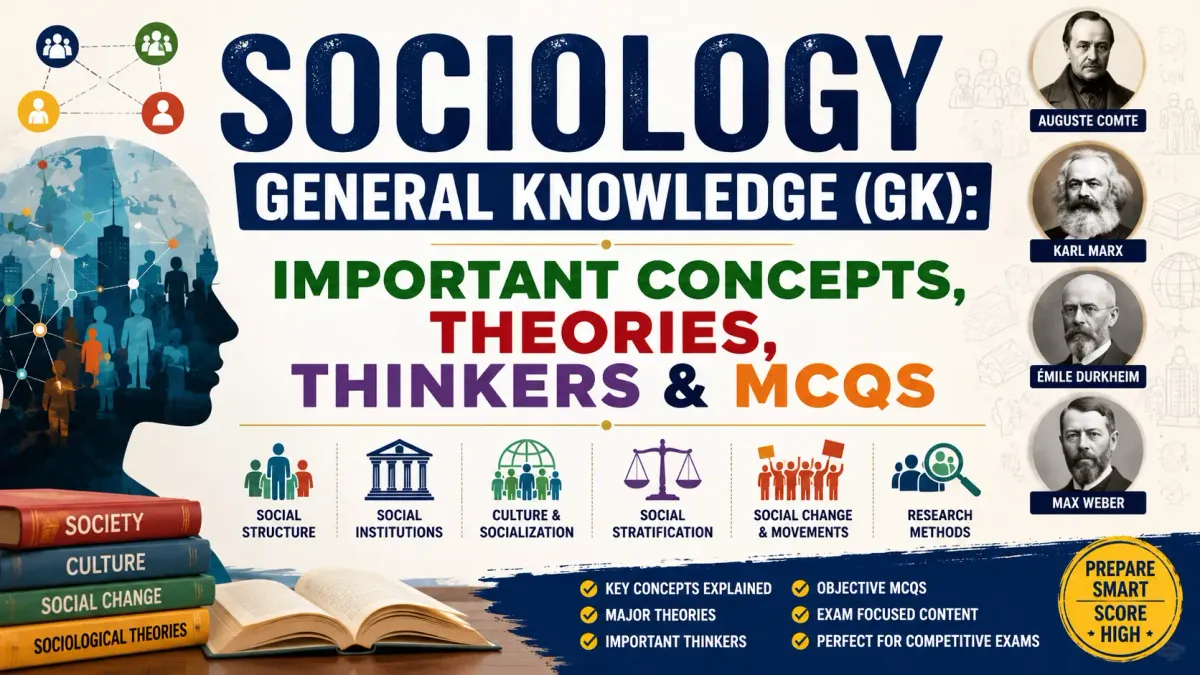
Sociology General Knowledge is an important subject for students, competitive exam aspirants, researchers, and anyone interested in understanding human society and social behavior. Sociology is the scientific study of society, social relationships, institutions, culture, and the various factors that influence human interactions. It helps individuals understand how societies function, how social structures are formed, and how social change takes place over time.
A strong foundation in Sociology General Knowledge is essential for preparing for various competitive examinations such as UPSC, APSC, SSC, State Public Service Commission exams, UGC NET, TET, and other government recruitment tests. Questions related to sociology often cover topics such as social institutions, social stratification, culture, socialization, family, education, religion, social change, social movements, and important sociologists and their contributions.
The study of sociology introduces learners to key concepts such as society, community, culture, norms, values, status, role, social groups, and social control. Understanding these concepts helps explain how individuals interact within a society and how social order is maintained. Sociology also examines major social issues such as poverty, unemployment, inequality, crime, gender discrimination, urbanization, globalization, and environmental challenges.
Sociology General Knowledge includes the study of influential sociologists and thinkers who have shaped the discipline. Prominent figures such as Auguste Comte, Karl Marx, Max Weber, and Émile Durkheim have contributed significantly to sociological theories and perspectives. Their ideas continue to influence modern sociological research and understanding.
Another important aspect of Sociology General Knowledge is the study of social institutions such as family, education, religion, economy, and politics. These institutions play a crucial role in shaping social behavior and maintaining stability within society. Sociology also explores how culture influences people's beliefs, customs, traditions, and lifestyles, making it a valuable subject for understanding diverse societies and communities around the world.
For competitive examinations, Sociology GK often includes multiple-choice questions (MCQs), definitions, important theories, sociological concepts, and current social issues. Regular practice of sociology questions and answers can help candidates improve their knowledge and perform better in examinations. Topics such as social mobility, caste system, class system, demographic changes, population studies, and social reforms are frequently included in exam syllabi.
Whether you are a student, educator, researcher, or exam aspirant, Sociology General Knowledge provides valuable insights into the structure and functioning of society. By studying sociology, learners develop critical thinking skills, social awareness, and a deeper understanding of human behavior and social processes. This comprehensive Sociology GK resource aims to help users learn important sociological concepts, theories, thinkers, and exam-oriented questions in a simple and easy-to-understand manner, making it an ideal study companion for academic and competitive exam success.
1. Who defines "Sociology may be defined as scientific knowledge about human relations"
(A) Ward
(B) Giddings
(C) Cuber
(D) Johnson
Correct Answer: (C) Cuber
2. "The culture of a society is the way of life of its members; the collection of ideas and habits which they learn, share and transmit from generation to generation"
(A) C. Kluckhohn
(B) E. B. Taylor
(C) F. Davis
(D) R. Linton
Correct Answer: (D) R. Linton
3. A primary group is characterized by
(A) blood relationship
(B) direct cooperation
(C) intimate face-to-face association
(D) moral and ethical relationship
Correct Answer: (C) intimate face-to-face association
4. Who among the following introduced the term "mores"
(A) W. G. Summer
(B) H. Hart
(C) C. Lombroso
(D) J. Piaget
Correct Answer: (A) W. G. Summer
5. "Science of Society is possible", is assumed by which approach
(A) Humanist
(B) Positivist
(C) Functionalist
(D) Feminist
Correct Answer: (A) W. G. Summer
6. Who propounded the concept of "reference group"
(A) W. I. Thomas
(B) C. R. Mills
(C) W Waller
(D) H. H. Hyman
Correct Answer: (D) H. H. Hyman
7. Herbert Spencer's name is associated with
(A) positivism
(B) organicism
(C) functionalism
(D) determinism
Correct Answer: (B) organicism
8. Who among the following developed the sociometry method
(A) P. V. Young
(B) Karl Pearson
(C) H. M. Johnson
(D) J. L. Moreno
Correct Answer: (D) J. L. Moreno
9. What is a type of marriage called when the brother of a deceased man is obliged to marry his brother's widow
(A) Levirate
(B) Sororate
(C) Adelphic polyandry
(D) Adelphic polygyny
Correct Answer: (A) Levirate
10. What are the two basic features of the community
(A) Heterogeneity and Integrity
(B) Proximity and Stability
(C) Homogeneity and Conflict
(D) Continuity and Change
Correct Answer: (B) Proximity and Stability
11. Which is the main basis of Association according to Tonnies
(A) Social Interest
(B) Political Interest
(C) Economic Interest
(D) Cultural Interest
Correct Answer: (C) Economic Interest
12. The book "Kinship Organization in India" was written by
(A) Kingsley Davis
(B) Patricia Uberoi
(C) D. N. Majumdar
(D) Iravati Karve
Correct Answer: (D) Iravati Karve
13. Who among the following was/were advocate(s) of the functionalist theory of stratification
(A) E. Durkheim
(B) Kingsley Davis
(C) Ogburn and Nimkoff
(D) R. W. Murray
Correct Answer: (B) Kingsley Davis
14. Which of the following concepts is associated with Thorstein Veblen's name
(A) Alienation
(B) Cultural tourism
(C) Leisure class
(D) Consumerism
Correct Answer: (C) Leisure class
15. The process by which the cultural traits invented or discovered in one society spread directly or indirectly to other societies is called
(A) Cultural relativism
(B) Cultural diffusion
(C) Ethnocentrism
(D) Assimilation
Correct Answer: (B) Cultural diffusion
16. Which of the following may be included in Social Norms
(A) Law
(B) Mores
(C) Custom
(D) All
Correct Answer: (D) All
17. Who coined the term "role-set"
(A) Radcliffe Brown
(B) Herbert Spencer
(C) C. H. Cooley
(D) R. K. Merton
Correct Answer: (D) R. K. Merton
18. Who is the author of the book "crime and custom in savage society"
(A) B. Malinowski
(B) H. Maine
(C) J. Frazer
(D) E. A. Ross
Correct Answer: (A) B. Malinowski
19. Who has argued that "sociology has a long past but only a short history"
(A) Bottomore
(B) Bierstedt
(C) Spencer
(D) Marx
Correct Answer: (B) Bierstedt
20. The estate system is characterized by
(A) Legal rights and duties
(B) Division of labor
(C) Political groups
(D) All of the above
Correct Answer: (D) All of the above
21. "Sociology is the study of the forms of social relations", who said this
(A) E Durkheim
(B) R. M. Maclver and C. H. Page
(C) G. Simmel
(D) M. Ginsberg
Correct Answer: (C) G. Simmel
22. Who coined the terms "Gemeinschaft" and "Gesellschaft"
(A) Karl Marx
(B) M. Weber
(C) F. Tonnies
(D) G. Simmel
Correct Answer: (C) F. Tonnies
23. Who amongst the following viewed crime as an inevitable, normal, and integral part of healthy societies
(A) Durkheim
(B) Marx
(C) Weber
(D) Pareto
Correct Answer: (A) Durkheim
24. Who coined the terms "little traditions" and "great traditions"
(A) Milton Singer
(B) Robert Redfield
(C) Harold Gould
(D) Y. Singh
Correct Answer: (B) Robert Redfield
25. The term "ethnocentrism" was coined by
(A) Theodor Adorno
(B) E. Burgess
(C) C. Darwin
(D) W. G. Sumner
Correct Answer: (D) W. G. Sumner
26. Who among the following had divided sociology into two major parts, namely static and dynamic sociology
(A) Auguste Comte
(B) Hegel
(C) Rudolph
(D) Hobhouse
Correct Answer: (A) Auguste Comte
27. Who considers poverty as a result of exploitation and not of scarcity
(A) Weber
(B) Plato
(C) Marx
(D) Pareto
Correct Answer: (C) Marx
28. The study of the vital processes of population aggregates is called
(A) Ecology
(B) Demography
(C) Statistics
(D) Anthropology
Correct Answer: (B) Demography
29. Who is the author of the book "The Golden Bough"
(A) G. Thomson
(B) J. Frazer
(C) B. Malinowski
(D) L. H. Morgan
Correct Answer: (B) J. Frazer
30. Who among the following thinkers is associated with the terms "id", "ego" and "superego"
(A) Carl G. Jung
(B) Gordon Allport
(C) Kimbal Young
(D) Sigmund Freud
Correct Answer: (D) Sigmund Freud
31. Who propounded the concepts of "manifest function" and "latent function"
(A) Robert Merton
(B) Talcott Parsons
(C) L. T. Hobhouse
(D) Marion Levy
Correct Answer: (A) Robert Merton
32. Who introduced the social distance scale
(A) Bogardus
(B) Bossard
(C) Reissmann
(D) Thomlinson
Correct Answer: (A) Bogardus
33. Who advocated the importance of keeping social sciences or its analysis ethically neutral or value free
(A) Comte
(B) Hobhouse
(C) Durkheim
(D) Weber
Correct Answer: (D) Weber
34. Who has classified action in logical and non-logical categories
(A) Parsons
(B) Pareto
(C) Spencer
(D) Mead
Correct Answer: (B) Pareto
35. Who consider poverty as a result of exploitation and not of scarcity
(A) Weber
(B) Hobhouse
(C) Marx
(D) Peter Blau
Correct Answer: (C) Marx
36. Who first used the term "phenomenology" as a principle of philosophical and scientific methods
(A) Peter Burger
(B) J. Turner
(C) Edmund Husserl
(D) Harold Garfinkel
Correct Answer: (C) Edmund Husserl
37. Who formulated the concept of "marginal man" in sociology
(A) W. Whyte
(B) R. K. Merton
(C) R. M. Maclever and C. H. Page
(D) R. Park and E. V. Stonequist
Correct Answer: (D) R. Park and E. V. Stonequist
38. Who is the author of the book "The Structure of Hindu Society"
(A) N. K. Bose
(B) Y. Singh
(C) M. N. Srinivas
(D) G. S. Ghurye
Correct Answer: (A) N. K. Bose
39. The term sociology was coined by
(A) Herbert Spencer
(B) Saint Simon
(C) Auguste Comte
(D) Max Weber
Correct Answer: (C) Auguste Comte
40. In which year the term "Sociology" was coined
(A) 1798
(B) 1815
(C) 1820
(D) 1838
Correct Answer: (D) 1838
41. Khasi tribes living in the hills of Meghalaya are
(A) Matrilineal
(B) Patrilineal
(C) Bi-lineal
(D) Cognatic
Correct Answer: (A) Matrilineal
42. The word family has been derived from the word "famulus" which is a ________ word
(A) Greek
(B) Latin
(C) Spanish
(D) Roman
Correct Answer: (B) Latin
43. Who wrote the volumes on "Theory of communicative Actions"
(A) Max Weber
(B) Juergen Habermas
(C) Karl Max
(D) Sorokin
Correct Answer: (B) Juergen Habermas
44. Which approach of qualitative research has emphasized on socio-linguistic aspects of social reality
(A) Phenomenology
(B) Post Modernism
(C) Ethnomethodology
(D) None of the above
Correct Answer: (C) Ethnomethodology
45. Who gave the concept of Neo-functionalism
(A) Robert Merton
(B) J. Alexander
(C) Kingsley Devis
(D) Talcote Parsons
Correct Answer: (B) J. Alexander
46. Who has given the notion of "Democracy" and "Public Sphere"
(A) Juergen Habermas
(B) Ulrich Beck
(C) Anthony Giddens
(D) Michel Foucault
Correct Answer: (A) Juergen Habermas
47. A position or rank that is assigned to a person at birth and cannot be changed is
(A) A closed status
(B) A fixed status
(C) An achieved status
(D) An ascribed status
Correct Answer: (D) An ascribed status
48. Concept of culture lag is given by
(A) Kingsley Davis
(B) Nimcoff
(C) Ogburn
(D) Mclver
Correct Answer: (C) Ogburn
49. The concept of "Reflexive role taking" was given by
(A) Merton
(B) Linton
(C) Coley
(D) G. H. Mead
Correct Answer: (D) G. H. Mead
50. Who said "There are no roles without statuses or statuses without roles"
(A) Ralph Linton
(B) Robert Park
(C) S. F. Nadel
(D) R. K. Merton
Correct Answer: (A) Ralph Linton
51. 'A nucleus of blood relatives surrounded by a fringe of spouses', the brothers and sisters representing the core of the family unit, is known as
(A) Consanguinal family
(B) Conjugal family
(C) Extended family
(D) None of the above
Correct Answer: (A) Consanguinal family
52. Who among the following contributed to the concept of dominant caste
(A) S. C. Dubey
(B) R. K. Mukherjee
(C) M. N. Srinivas
(D) D. P. Mukherjee
Correct Answer: (C) M. N. Srinivas
53. Which among the following is not an agent of political socialization
(A) State
(B) Caste
(C) Media
(D) Family
Correct Answer: (B) Caste
54. Who made the statement "State is a special repressive force of the suppression of the proletariat by the bourgeois, of millions of toilers by handful of rich"
(A) Karl Marx
(B) Lenin
(C) Maclver
(D) F. Engels
Correct Answer: (B) Lenin
55. Who among the following written the book "The Power Elite"
(A) V. Pareto
(B) G. Mosca
(C) C. Wright Mills
(D) None of the above
Correct Answer: (C) C. Wright Mills
56. Who gave the concept of Sanskritization
(A) G. S. Ghurye
(B) M. N. Srinivas
(C) Yogendra Singh
(D) C. Parvathamma
Correct Answer: (B) M. N. Srinivas
57. According to Husserl reality can be understood by
(A) Scientific method
(B) Social survey
(C) Contextual experience
(D) Relative experience
Correct Answer: (C) Contextual experience
58. Who is the predecessor of Ethnomethodology
(A) Husserl
(B) Harold Garfinkel
(C) Goffman
(D) Blummer
Correct Answer: (B) Harold Garfinkel
59. Which is the features of Ethnomethodological theory
(A) Accounts of interaction
(B) Meanings of interactions
(C) Methodology
(D) All of the above
Correct Answer: (D) All of the above
60. Who has written the book "System of Positive Polity"
(A) E. Leach
(B) Auguste Comte
(C) Herbert Spencer
(D) R.E. Park
Correct Answer: (B) Auguste Comte
61. The collection of roles that goes with a given status is termed as
(A) Multiple Roles
(B) Role Set
(C) Conflict of roles
(D) Summation of roles
Correct Answer: (B) Role Set
62. Who said that 'society is web of social relationship'
(A) Weber
(B) Maclver
(C) Marx
(D) Durkheim
Correct Answer: (B) Maclver
63. Who said that 'sociology is the science of collective behavior'
(A) Durkheim
(B) Park and Burgess
(C) Weber
(D) Bernard
Correct Answer: (B) Park and Burgess
64. Advance organizer model was the result of the efforts of
(A) Bruce Joyce
(B) David Ausubel
(C) John Ausubel
(D) Joyce and Weil
Correct Answer: (B) David Ausubel
65. The book "Principles of Psychology" is authored by
(A) John Dewey
(B) William James
(C) Ebbinghaus
(D) Wundt
Correct Answer: (B) William James
66. Who is the profounder of the concept of "Global village"
(A) R. Gilpin
(B) Malcolm Waters
(C) Marshall McLuhan
(D) Anthony Giddens
Correct Answer: (C) Marshall McLuhan
67. Who said "Sociology is the study of social groups"
(A) H.M. Johnson
(B) A.M. Rose
(C) Maclver and Page
(D) Max Weber
Correct Answer: (A) H.M. Johnson
68. Who introduces the concept of "Role set" in sociology
(A) Linton
(B) Merton
(C) Veblen
(D) Weber
Correct Answer: (B) Merton
69. Who has propounded the concept of "white collar crime"
(A) Cohen
(B) Merton
(C) Parsons
(D) Sutherland
Correct Answer: (D) Sutherland
70. The concept of "Formal sociology" has been given by
(A) George Simmel
(B) T.B. Bottomore
(C) Sorokin
(D) Bogardus
Correct Answer: (A) George Simmel
71. Who is the author of the book "Social Thought from Lore to Science"
(A) Alex Inkels
(B) Peter Berger
(C) Harry Elmer Barnes
(D) Howard Becker
Correct Answer: (C) Harry Elmer Barnes
72. The study of forms of social relationship is identified as the scope of sociology by
(A) Maclver
(B) Small
(C) Max Weber
(D) Simmel
Correct Answer: (B) Small
73. Who has given the concept of 'Reflexive role taking'
(A) Merton
(B) Linton
(C) Cooley
(D) G. H. Mead
Correct Answer: (D) G. H. Mead
74. Who has said that "A role is a set of socially accepted and approved behavior pattern consisting of both duties and privileges"
(A) Ogburn and Nimkoff
(B) Kingsley Davis
(C) R. K. Merton
(D) Maclver
Correct Answer: (A) Ogburn and Nimkoff
75. The practice of marrying outside one's class is called
(A) Exogamy
(B) Endogamy
(C) Hypergamy
(D) Hypogamy
Correct Answer: (A) Exogamy
76. The result of social interaction is _________
(A) social stratification
(B) social value
(C) social process
(D) social pattern
Correct Answer: (C) social process
77. Who has classified status into "ascribed" and "achieved"
(A) Robert Bierstedt
(B) Ralph Linton
(C) H.M. Johnson
(D) R.M. Maclver
Correct Answer: (B) Ralph Linton
78. "Primary groups are nurseries of human nature" This is stated by
(A) H.M. Johnson
(B) Herbert Spencer
(C) George Simmel
(D) C.H. Cooley
Correct Answer: (D) C.H. Cooley
Q79. Any small group marked by continuous close interaction of a highly personal and emotionally supportive nature is called
(A) Reference group
(B) Primary group
(C) Interest group
(D) Secondary group
Correct Answer: (B) Primary group
80. The group other than one's own group shaping the behavior of an individual is called
(A) ingroup
(B) outgroup
(C) primary group
(D) reference group
Correct Answer: (D) reference group
81. Who has classified the groups as ingroup and outgroup
(A) W.G. Sumner
(B) Laster F. Ward
(C) C.H. Cooley
(D) J.H. Fichter
Correct Answer: (A) W.G. Sumner
82. Who has given the idea of consciousness of kind
(A) H.M. Johnson
(B) R.M. Maclver
(C) F.H. Giddings
(D) None of these
Correct Answer: (C) F.H. Giddings
83. Who has defined the concept of "Looking Glass Self" among the following
(A) G.H. Mead
(B) S. Freud
(C) C.H. Cooley
(D) D.H. Wrong
Correct Answer: (C) C.H. Cooley
84. A developed society is characterized by
(A) Particularistic value
(B) Diffuseness value
(C) Ascription value
(D) Specificity value
Correct Answer: (D) Specificity value
85. Interpretative sociology's basic unit of analysis is
(A) organization
(B) structure
(C) system
(D) action
Correct Answer: (D) action
86. Who among the following gave a linear explanation for the evolution of human societies
(A) Pareto
(B) Weber
(C) Spencer
(D) Sorokin
Correct Answer: (C) Spencer
87. Conspicuous consumption is an example of
(A) Manifesto function
(B) Latent function
(C) Confunction
(D) Disfunction
Correct Answer: (A) Manifesto function
88. Anomic suicide is the result of
(A) Low social integration
(B) Low social regulation
(C) High social integration
(D) High social regulation
Correct Answer: (B) Low social regulation
89. Who has given the concept of "functional alternatives"
(A) Talcott Parsons
(B) Robert K. Merton
(C) Albert Cohen
(D) Emile Durkheim
Correct Answer: (B) Robert K. Merton
90. Who regards deviance as functional for society
(A) Albert Cohen
(B) Robert K. Merton
(C) Emile Durkheim
(D) Radcliffe Brown
Correct Answer: (C) Emile Durkheim
91. Who among the following drew a distinction between "social structure" and "structured form"
(A) Radcliffe Brown
(B) S.F. Nadel
(C) Edmund Leach
(D) Evans Pritchard
Correct Answer: (A) Radcliffe Brown
92. "Structure and Function in Primitive Society" is written by
(A) B.K. Malinowski
(B) Radcliffe Brown
(C) Ferdinard de Saussure
(D) Claude Levi-Strauss
Correct Answer: (B) Radcliffe Brown
93. An institution can be best described as a complex of
(A) Authority
(B) Statuses
(C) Roles
(D) Procedures
Correct Answer: (D) Procedures
94. Which one of the following is so important for the society that its violation calls for severe punishment
(A) Customs
(B) Mores
(C) Ideologies
(D) Folkways
Correct Answer: (B) Mores
95. Sociological perspective involves a process of 'seeing through' — who said
(A) Peter Berger
(B) Auguste Comte
(C) C. Wright Mills
(D) Karl Marx
Correct Answer: (A) Peter Berger
96. The principle of natural selection was first applied in sociology by
(A) Herbert Spencer
(B) Radcliffe Brown
(C) Von Wiese
(D) F. Tonnies
Correct Answer: (A) Herbert Spencer
97. The book 'The Theory of Social Structure' is authored by
(A) Levi-Strauss
(B) A.R. Radcliffe Brown
(C) S.F. Nadel
(D) B. Malinowski
Correct Answer: (C) S.F. Nadel
98. Which among these two creates a situation for role conflict
(A) Conflict within a single role
(B) Conflict between roles
(C) Both (A) and (B)
(D) None of the above
Correct Answer: (B) Conflict between roles
99. Who has classified status into "ascribed" and "achieved"
(A) Robert Bierstedt
(B) H.M. Johnson
(C) R.M. Mac Iver
(D) Ralph Linton
Correct Answer: (D) Ralph Linton
100. "Primary Groups are the nurseries of human nature." This is stated by
(A) H.M. Johnson
(B) Herbert Spencer
(C) George Simmel
(D) C.H. Cooley
Correct Answer: (D) C.H. Cooley
101. Who has given the 'idea of consciousness' of kind
(A) H.M. Johnson
(B) R.M. Mac Iver
(C) F.H. Giddings
(D) None of the above
Correct Answer: (C) F.H. Giddings
102. The concept of the 'Marginal Man' is developed by
(A) Robert Redfield
(B) Robert Park
(C) Robert Merton
(D) Erwin Goffman
Correct Answer: (B) Robert Park
103. Book 'Anatomy of Rural-Urban Community' is written by
(A) M.S.A. Rao
(B) G.S. Ghurye
(C) Patrick Geddes
(D) A.M. Shah
Correct Answer: (B) G.S. Ghurye
104. Radcliffe Brown's first ethnographic study was on the
(A) Nicobar Islands
(B) Jersey Islands
(C) Pacific Islands
(D) Andaman Islands
Correct Answer: (D) Andaman Islands
105. 'Rurbanism' is the term that is related to the study of
(A) Villages
(B) Town and Cities
(C) Rural Areas
(D) Lifestyle of people rural-urban
Correct Answer: (D) Lifestyle of people rural-urban
106. The statement 'religion is heart of the heartless' is attributed to
(A) Karl Marx
(B) Emile Durkheim
(C) Radcliffe Brown
(D) Max Weber
Correct Answer: (A) Karl Marx
107. The term social structure refers to "an ordered arrangement" of parts as viewed by
(A) S.F. Nadel
(B) Levi-Strauss
(C) R. Lowie
(D) R.K. Merton
Correct Answer: (A) S.F. Nadel
108. Who regards 'deviance' functional for society
(A) Albert Cohen
(B) Robert K. Merton
(C) Emile Durkheim
(D) Radcliffe Brown
Correct Answer: (B) Robert K. Merton
109. Which of the following concepts does not figure in Malthusian theory of population
(A) Arithmetic progression
(B) Positive checks
(C) Stable population
(D) Preventive checks
Correct Answer: (C) Stable population
110. Who among the following is associated with the Human Development Index (HDI) for measuring the level of development among various countries
(A) Mahbub-ul-Haque
(B) Raymond Firth
(C) M.N. Srinivas
(D) PA.R. Desai
Correct Answer: (A) Mahbub-ul-Haque
111. E. Sutherland founded the theory of
(A) Blue Collar Crime
(B) Crime by Dacoits
(C) White Collar Crime
(D) Cyber Crime
Correct Answer: (C) White Collar Crime
112. All countries pass through various stages of demographic transition. Which one of the following is not such a stage
(A) High birth rate
(B) Decline in death rate
(C) Low steady death and birth rate
(D) Optimum stage
Correct Answer: (D) Optimum stage
113. Who introduced the concept/term 'post-industrial society'
(A) J. Burnham
(B) G.K. Galbraith
(C) Daniel Bell
(D) R. Dahrendorf
Correct Answer: (C) Daniel Bell
114. Which group of the feminists accept the view that 'State is a system of structures and institutions created by man in order to recreate male domination and female subordination'
(A) Liberal Feminists
(B) Radical Feminists
(C) Marxist Feminists
(D) Eco Feminists
Correct Answer: (B) Radical Feminists
115. The term 'Sociological Imagination' was coined by whom
(A) C.W. Mills
(B) Peter Berger
(C) A. Giddens
(D) J.S. Mill
Correct Answer: (A) C.W. Mills
116. Stages of cognitive development related socialization was proposed by
(A) H. Mead
(B) S. Freud
(C) C.H. Cooley
(D) J. Piaget
Correct Answer: (D) J. Piaget
117. Which one of the following is known as the process by which cultural traits spread from one culturally distinct group to another
(A) Evolution
(B) Assimilation
(C) Accommodation
(D) Diffusion
Correct Answer: (D) Diffusion
118. The Weberian model of social stratification has been used in the study of caste by
(A) S.C. Dube
(B) M.N. Srinivas
(C) Andre Beteille
(D) T.N. Madan
Correct Answer: (C) Andre Beteille
119. Who has talked about 'decomposition of labour'
(A) Karl Marx
(B) G. Simmel
(C) L. Coser
(D) R. Dahrendorf
Correct Answer: (D) R. Dahrendorf
120. According to Karl Marx, which one of the following is not a dimension of alienation
(A) Alienation from Production
(B) Alienation from Labour
(C) Alienation from Nature
(D) Alienation from Self
Correct Answer: (C) Alienation from Nature
121. The book on "The Phenomenology of the Social World" is written by
(A) Edmund Husserl
(B) Edmund Husserl
(C) Karl Manheim
(D) Alfred Schultz
Correct Answer: (D) Alfred Schultz
122. ........ have explained the duplicity of people's soöially constructed reality
(A) Peter Berger and Thomas Luckman
(B) Karl Marx and Max Weber
(C) Karl Manheim and E. Durkheim
(D) E. Husserl and Alfred Schultz
Correct Answer: (A) Peter Berger and Thomas Luckman
123. .......is the field of inquiry that seeks to understand the methods people employ to make sense out of their world
(A) Symbolic Interactionism
(B) Phenomenology
(C) Ethnomethodology
(D) Dialectical method
Correct Answer: (B) Phenomenology
124. Name the sociologist who suggested that human behaviour is regulated by means of "Surveillance"
(A) M. Foucault
(B) T. Parsons
(C) J. Derrida
(D) A. Giddens
Correct Answer: (A) M. Foucault
125. Who has developed the concept of 'Structuration'
(A) Jacques Derrida
(B) Pierre Bourdieu
(C) Anthony Giddens
(D) Maurice Godelier
Correct Answer: (C) Anthony Giddens
126. Pluralistic society shares the characteristics of
(A) Capitalistic society
(B) Post-modernistic society
(C) Industrial society
(D) Post-industrial society
Correct Answer: (B) Post-modernistic society
127. Who among the following distinguishes three components of the 'life world' — culture, society and personality
(A) A. Schultz
(B) E. Husserl
(C) P. Berger
(D) J. Habermas
Correct Answer: (D) J. Habermas
128. Who among the following theorists sees contemporary society as a death culture, with death being the 'paradigm' of all social exclusion and discrimination
(A) J. Baudrillard
(B) U. Beck
(C) M. Foucault
(D) J.F. Lyotard
Correct Answer: (A) J. Baudrillard
129. Who has considered that 'most often action is routine and relatively unreflexive'
(A) Alfred Schultz
(B) H. Garfinkel
(C) Max Weber
(D) John Heritage
Correct Answer: (A) Alfred Schultz
130. Who has observed a link between the structures of the mind and the structures of society
(A) Charles Lemert
(B) Radcliffe Brown
(C) Levi-Strauss
(D) Michel Foucault
Correct Answer: (C) Levi-Strauss
131. Who has criticized the economic determinism to be implicit in parts of Marx's original work
(A) J. Habermas
(B) T. Bottomore
(C) J. Morrow
(D) L. Althusser
Correct Answer: (A) J. Habermas
132. The concept of 'Symmetrical Family' has been propounded by
(A) M. Young and P. Willmott
(B) Oakley
(C) Bauman and Smart
(D) Smart
Correct Answer: (A) M. Young and P. Willmott
133. Who is of the opinion that the notion of the fundamental opposition between the pure and the impure is the hallmark of the caste system
(A) M.N. Srinivas
(B) Louis Dumont
(C) Surjit Sinha
(D) B.R. Ambedkar
Correct Answer: (B) Louis Dumont
134. Which type of sampling method is ideally suited, where there is no knowledge about population
(A) Convenient sampling method
(B) Purposive sampling method
(C) Quota sampling method
(D) Snowball sampling method
Correct Answer: (D) Snowball sampling method
135. Which of the following is associated with Descriptive Design
(A) Analysis of Demographic Trends
(B) Internal-consistency reliability
(C) Split-half reliability
(D) Content-level reliability
Correct Answer: (A) Analysis of Demographic Trends
136. Who said "History is past sociology, and sociology is present History"
(A) Robert Bierstedt
(B) Aristotle
(C) G.E. Howard
(D) H.T. Mazumdar
Correct Answer: (C) G.E. Howard
137. Who is the author of the book "The Protestant Ethic and the Spirit of Capitalism".
(A) Max Weber
(B) Karl Marx
(C) Herbert Spencer
(D) C.H. Cooli
Correct Answer: (A) Max Weber
138. The concept of "Anomie" was introduced to sociology by
(A) August Comte
(B) Max Weber
(C) Karl Marx
(D) Emile Durkheim
Correct Answer: (D) Emile Durkheim